
On this page
- Is Quinoa Grown in India?
- What Are the Basics of the Quinoa Plant?
- Where Does Quinoa Grow in India?
- What Climate, Soil and Sowing Season Does Quinoa Need?
- What Is the Growing Cycle from Sowing to Harvest?
- How Is Quinoa Harvested and Processed After Harvest?
- What Are the Challenges for Indian Quinoa Farming?
- How Do You Source Quinoa from India with Elysium?
- Frequently asked questions
Yes, quinoa is grown in India. Farmers plant quinoa seeds in the rabi (winter) season, from October to December, mainly in Rajasthan and Andhra Pradesh, and harvest the crop in February and March, about 120–130 days after sowing. Quinoa is a young crop in India, grown commercially only since the mid-2010s. This guide explains the plant, where and how it grows in India, the growing cycle, post-harvest processing and the main challenges for farmers and buyers.
Key takeaways
- India grows quinoa as a rabi crop, sown October to December and harvested February to March.
- Rajasthan and Andhra Pradesh are the main growing states, with smaller areas in Madhya Pradesh, Karnataka and the Himalayan region.
- The crop needs cool weather, little water and well-drained soil, and it matures in about 120–140 days.
- After harvest, quinoa must be washed or scarified to remove bitter saponin before it is sold as food.
Is Quinoa Grown in India?
Yes. Quinoa is native to the Andes of South America, but Indian farmers have grown it commercially since the mid-2010s. Interest rose after the United Nations named 2013 the International Year of Quinoa, which drew attention to its nutrition and its tolerance of poor soils and dry weather. State agencies, ICAR research centres and private companies then ran trials and field demonstrations in dry regions of India.
Indian quinoa is still small compared with the crops of Peru and Bolivia. But it has found a place in the market. It is harvested in February and March, earlier than the South American crop, and freight to the Middle East and Asia is short. Indian white quinoa is usually a little smaller and milder than Peruvian or Bolivian quinoa. See our Indian quinoa page for the full export specification.
What Are the Basics of the Quinoa Plant?
Quinoa (Chenopodium quinoa Willd.) is a broad-leaved annual plant from the amaranth family. It is not a true cereal, because it is not a grass like wheat or rice. For this reason it is called a pseudocereal. Its seeds are cooked and eaten like a grain and are naturally gluten-free.
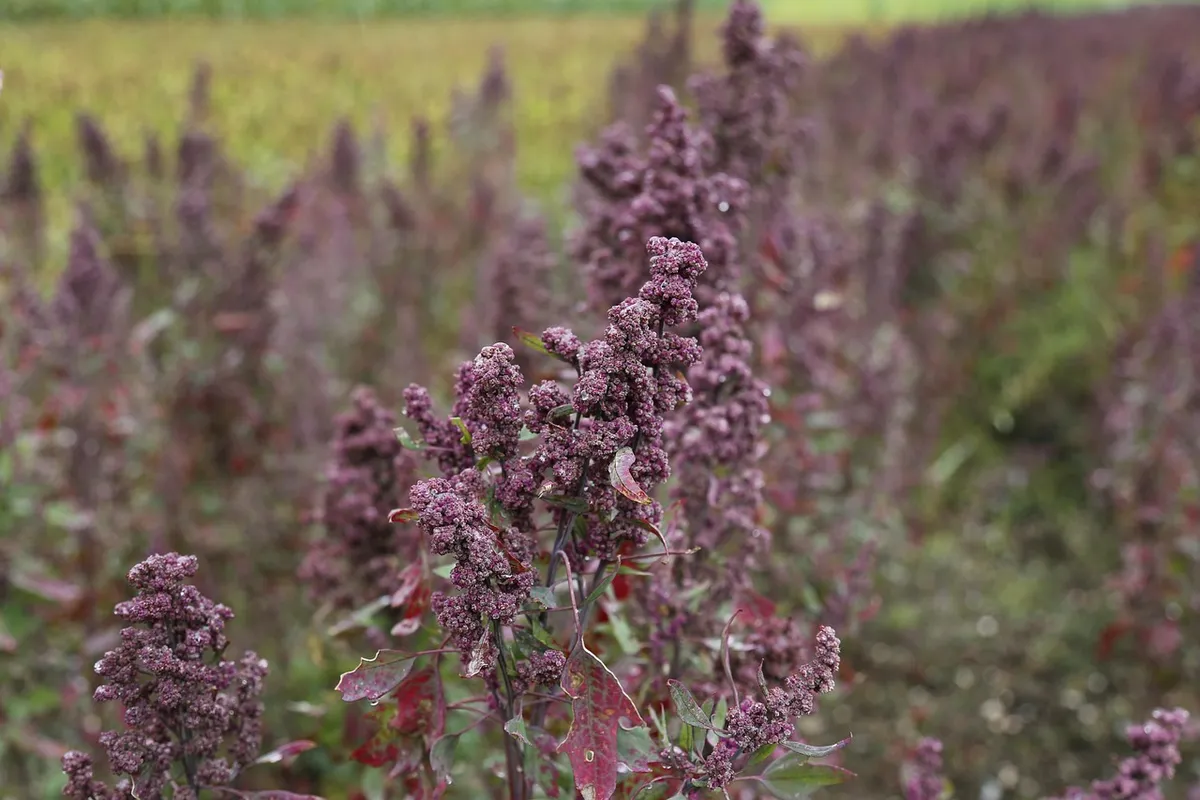
The plant usually grows between one and two metres tall. It has a single main stem, lobed leaves and a large seed head, called a panicle, at the top. The panicle holds hundreds of small, round seeds. Depending on the variety, the seed head can be green, cream, red or purple as it ripens. Each seed is covered with a thin layer of saponin, a bitter, soapy compound that protects the seed from birds and insects. Seed colour gives the main trade types: white, red and black quinoa. Most Indian production is white quinoa.
Where Does Quinoa Grow in India?
Most Indian quinoa is grown in Rajasthan and in Andhra Pradesh, especially the Anantapur district. Smaller areas are grown in Madhya Pradesh, Karnataka and the Himalayan states. These regions share a dry winter with cool nights and mild days, which suits the crop.
- Rajasthan: the largest area, mainly in dry western and south-eastern districts. ICAR research centres in the state have run field demonstrations for farmers.
- Andhra Pradesh: the dry Anantapur district grows quinoa as an alternative to water-hungry crops.
- Other states: trials and small commercial plots in Madhya Pradesh, Karnataka, Uttarakhand and parts of the Himalayan region, including Ladakh.
Quinoa fits well into the rabi season of these states, alongside crops such as wheat, mustard and cumin. Our guide to harvest seasons of Indian crops shows where it sits in the farm year.
What Climate, Soil and Sowing Season Does Quinoa Need?
Quinoa needs cool weather during growth, little water, and light, well-drained soil. In India this means the rabi season, when days are mild and dry. Extension guidance gives an ideal growing temperature of about 18–24°C. The crop tolerates drought, ground frost and salty or alkaline soils better than most cereals. However, very high temperatures during flowering can reduce seed set, so late sowing is risky.
Sandy loam and loam soils with good drainage give the best results. Quinoa does not like waterlogging. The seeds are very small, so the field must be ploughed to a fine, level seedbed. In an ICAR-IISWC field demonstration in the black soils of south-eastern Rajasthan, farmers sowed in late November and mid-December. They used a seed rate of 5–6 kg per hectare, rows 30–45 cm apart and a sowing depth of 2–3 cm. The crop received one irrigation before sowing and one more about 55 days later. The best yields came from rows 45 cm apart, sown on 25 November.
What Is the Growing Cycle from Sowing to Harvest?
Quinoa takes about 120–140 days from sowing to harvest in India. The ICAR-IISWC crop in Rajasthan matured in 120–130 days. The table shows a typical rabi-season cycle. Exact dates vary with the variety, the sowing date and the weather.
| Stage | Approximate timing | What happens |
|---|---|---|
| Land preparation | Late September to November | Ploughing to a fine seedbed; pre-sowing irrigation |
| Sowing | October to December | Seeds sown 2–3 cm deep in rows 30–45 cm apart |
| Germination and early growth | First 2–4 weeks | Small seedlings; weeding and thinning are important |
| Vegetative growth | About 1–2 months after sowing | Plant branches and grows tall; light irrigation if needed |
| Panicle formation and flowering | About 2–3 months after sowing | Seed heads form; the crop is sensitive to heat and frost damage |
| Grain filling and ripening | About 3–4 months after sowing | Seeds harden; leaves turn yellow and drop |
| Harvest | February to March (120–140 days) | Panicles cut, dried and threshed |
A typical rabi-season quinoa cycle in India. Field timings vary by region and variety.
This timing means fresh Indian quinoa reaches the market from March onwards. Our crop calendar shows the harvest windows for quinoa and other Indian crops, which helps you plan contracts.
How Is Quinoa Harvested and Processed After Harvest?
Quinoa is harvested when the seeds are hard and the leaves have turned yellow. Farmers cut the panicles or whole plants, dry them in the sun, and then thresh them to separate the seed. Harvest timing matters. If the crop is cut too late, seeds can shatter or sprout in the head after rain. If it is cut too early, the seeds stay soft and high in moisture.
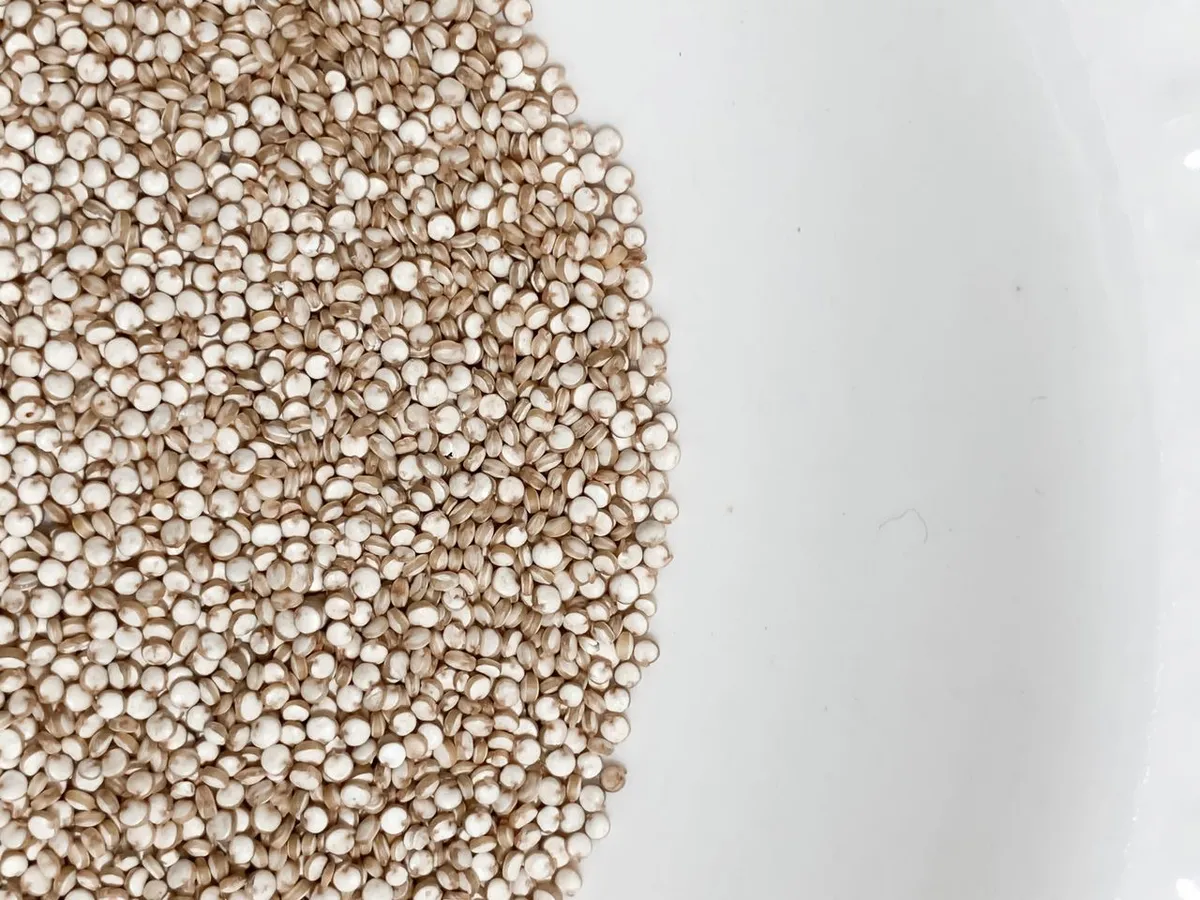
Raw quinoa is not ready to eat. The saponin coating must be removed first. Processors do this by washing the seed in water, by dry scarification (rubbing off the outer layer) or by both. The seed is then dried, cleaned, graded by size and passed through a sortex colour sorter to remove dark grains, stones and other matter. Our export quinoa is washed and scarified to a saponin level of 0.1% or less and sortex-cleaned to 99.5% purity or higher. Moisture is held at 12% or below for safe storage.
What Are the Challenges for Indian Quinoa Farming?
The main challenges are market access, a short history of local breeding, and weather risk at flowering and harvest. Quinoa is still a new crop for most Indian farmers, so several issues affect supply.
- Market and price: farmers need an assured buyer, because quinoa has limited demand in local mandis. Many grow it under contract or buy-back schemes.
- Varieties: few varieties are bred for Indian conditions, so yields and grain size vary between farms.
- Weather: heat during flowering, unseasonal rain at harvest and frost can all cut yield or quality.
- Processing: saponin removal and sortex cleaning need investment, so quality depends on the processor.
- Weeds and birds: young plants grow slowly at first and compete poorly with weeds. Birds can damage ripening heads.
For buyers, this means you should check the processing as closely as the farming. Ask for the saponin result, grain size class, purity and a lot-wise lab report. Our lab testing page explains what we test on each lot. Quinoa is often bought alongside millets; our guide on how millets grow covers those crops.
Related reading: Types of Quinoa: White, Red and Black Quinoa Compared and Protein Content of Quinoa: Nutrition Facts per 100 g.
How Do You Source Quinoa from India with Elysium?
Once farmers plant quinoa seeds and bring in the rabi harvest, the quality you receive depends on cleaning, testing and packing. We export Indian white quinoa grown in Rajasthan and Andhra Pradesh. It is washed and scarified to remove saponin, sortex-cleaned to 99.5% purity or higher, and tested to the Codex quinoa standard. Protein is 12% or more on a dry basis, and the grain is naturally gluten-free.
Indian quinoa usually costs 8–25% less than South American quinoa. We pack in 25 kg PP or paper bags or 1 MT FIBC bags, and a 40 ft container holds about 24–27 MT. We also offer private label packing. Tell us your grain size, purity, packing and destination.
Frequently asked questions
Can quinoa be grown in India?
Yes. Quinoa has been grown commercially in India since the mid-2010s. It grows as a rabi, or winter, crop in dry regions with cool weather and well-drained soil. Rajasthan and Andhra Pradesh are the main producers. Indian quinoa is mostly white, slightly smaller and milder than South American quinoa, and is harvested in February and March.
Where is quinoa grown in India?
Most Indian quinoa comes from Rajasthan and Andhra Pradesh, especially the Anantapur district. Smaller areas are grown in Madhya Pradesh, Karnataka, Uttarakhand and parts of the Himalayan region, including Ladakh. These regions have dry winters with cool nights and mild days, which suit the crop, and quinoa needs much less water than most cereals.
What climate does quinoa need to grow?
Quinoa grows best in cool, dry conditions, with an ideal growing temperature of about 18–24°C. It tolerates drought, ground frost and salty or alkaline soils better than most cereals. It needs well-drained sandy loam or loam soil and does not tolerate waterlogging. Very high temperatures at flowering can reduce seed set, so timely sowing matters.
When is quinoa sown and harvested in India?
In India quinoa is sown in the rabi season, from October to December, often in late November. It is harvested in February and March, when the seeds are hard and the leaves have turned yellow. This makes Indian quinoa available earlier in the year than the main South American harvest, which runs from April to July.
How long does quinoa take to mature?
Quinoa takes about 120 to 140 days from sowing to harvest in India, depending on the variety, sowing date and weather. In an ICAR field demonstration in south-eastern Rajasthan, the crop matured in 120 to 130 days. Late sowing can shorten the season and expose flowering plants to higher temperatures, which may reduce yield.
Related reads


