
On this page
- What Are the Nutrition Facts of Quinoa?
- Quinoa Nutrition per 100 g
- What Is the Protein Content of Quinoa, and Which Amino Acids Does It Have?
- How Much Carbohydrate, Fibre and Fat Does Quinoa Contain?
- Which Vitamins and Minerals Are in Quinoa?
- How Does Raw Quinoa Nutrition Compare with Cooked Quinoa?
- What Does the Research Say About Quinoa Nutrition?
- How Do You Source Quinoa in Bulk from India?
- Frequently asked questions
The protein content of quinoa is about 14.1 g per 100 g of dry, uncooked grain and about 4.4 g per 100 g once cooked, according to USDA FoodData Central. Quinoa also contains all nine essential amino acids, including more lysine than most cereals. This fact sheet sets out quinoa nutrition per 100 g, the amino acid profile, the vitamins and minerals, and how cooking changes the numbers. It is written for food manufacturers, brand owners and importers who need reliable figures for labels and product claims.
Key takeaways
- Uncooked quinoa gives 368 kcal, 14.1 g protein, 64.2 g carbohydrate, 7.0 g fibre and 6.1 g fat per 100 g (USDA).
- Cooked quinoa gives 120 kcal and 4.4 g protein per 100 g, because it absorbs water. The total protein in the grain does not fall.
- Quinoa supplies all nine essential amino acids and is a good source of magnesium, manganese, phosphorus, iron, folate and zinc.
- Codex sets a minimum of 10% protein for traded quinoa. Export lots from India are typically 12% or more on a dry basis.
What Are the Nutrition Facts of Quinoa?
Quinoa is a dense source of energy, complex carbohydrate and plant protein, with useful amounts of fibre, healthy fats and minerals. Per 100 g of dry grain, it gives 368 kcal, 14.1 g of protein, 64.2 g of carbohydrate (of which 52.2 g is starch), 7.0 g of dietary fibre and 6.1 g of fat. These values come from the USDA FoodData Central entry for uncooked quinoa, the reference most food brands use for labels.
Botanically, quinoa (Chenopodium quinoa Willd.) is not a cereal. It is the seed of a plant in the amaranth family, so it is often called a pseudocereal. It is cooked like a grain and is naturally gluten-free, which is why manufacturers use it in cereals, bars, bakery and ready meals.
Quinoa Nutrition per 100 g
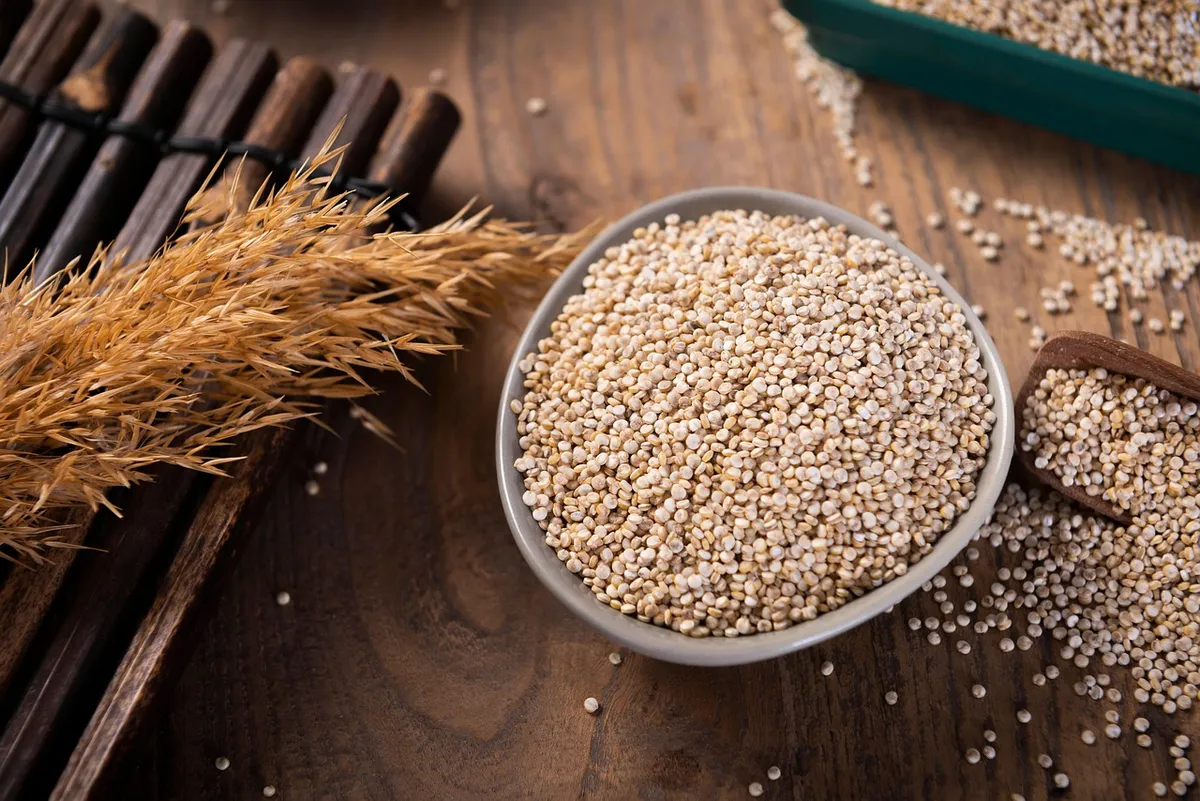
The table below compares uncooked and cooked quinoa per 100 g. All figures are from USDA FoodData Central (SR Legacy entries for uncooked and cooked quinoa).
| Nutrient (per 100 g) | Uncooked quinoa | Cooked quinoa |
|---|---|---|
| Energy | 368 kcal | 120 kcal |
| Water | 13.3 g | 71.6 g |
| Protein | 14.1 g | 4.4 g |
| Total fat | 6.07 g | 1.92 g |
| Carbohydrate | 64.2 g | 21.3 g |
| Starch | 52.2 g | 17.6 g |
| Dietary fibre | 7.0 g | 2.8 g |
| Magnesium | 197 mg | 64 mg |
| Phosphorus | 457 mg | 152 mg |
| Potassium | 563 mg | 172 mg |
| Iron | 4.57 mg | 1.49 mg |
| Zinc | 3.10 mg | 1.09 mg |
| Manganese | 2.03 mg | 0.63 mg |
| Folate | 184 µg | 42 µg |
| Sodium | 5 mg | 7 mg |
Quinoa nutrition per 100 g, uncooked and cooked. Source: USDA FoodData Central.
Values for any single lot differ a little with variety, soil and season. For labels, use the USDA figures as a reference or ask for a proximate analysis of the actual lot.
What Is the Protein Content of Quinoa, and Which Amino Acids Does It Have?
The protein content of quinoa is 14.1 g per 100 g uncooked, which is higher than rice and similar to or above most wheat. More important than the amount is the quality. Quinoa contains all nine essential amino acids, the ones the body cannot make, so it is often described as a complete plant protein.
Lysine is the amino acid that cereals usually lack, and quinoa has a good amount of it. USDA data list 0.77 g of lysine per 100 g of uncooked quinoa. That works out to about 54 mg of lysine per gram of protein, above the 45 mg/g reference pattern for adults in the WHO/FAO/UNU report on protein and amino acid requirements. The sulphur amino acids, methionine and cystine, add up to about 36 mg per gram of protein, also above the adult reference.
- Lysine: 0.77 g per 100 g uncooked.
- Leucine: 0.84 g per 100 g uncooked.
- Methionine: 0.31 g per 100 g uncooked.
- Cystine: 0.20 g per 100 g uncooked.
Commercial quinoa is also traded on protein. The Codex standard for quinoa (CXS 333-2019) sets a minimum of 10% protein on a dry basis. Our Indian white quinoa is specified at 12% or more, and is typically 13–15%. If you want to compare it with other high-protein seeds, see our guide to chia seeds vs flax seeds or the chickpea protein and nutrition fact sheet.
How Much Carbohydrate, Fibre and Fat Does Quinoa Contain?
Carbohydrate makes up about two-thirds of dry quinoa, at 64.2 g per 100 g. Most of it is starch (52.2 g). The rest is dietary fibre and small amounts of sugars.
Fibre is 7.0 g per 100 g uncooked. Quinoa is eaten as a whole seed, so its outer layers stay in the food. This is useful in gluten-free bakery, where fibre is often low.
Fat is 6.1 g per 100 g, which is higher than wheat or rice. More than half of it is polyunsaturated (3.29 g), with 1.61 g monounsaturated and only 0.71 g saturated. For product developers, this fat level matters for shelf life. Store quinoa and quinoa flour cool and dry, and use good barrier packaging for flour and flakes.
Which Vitamins and Minerals Are in Quinoa?
Quinoa is a strong source of minerals, especially magnesium, manganese, phosphorus, copper, iron and zinc, and it gives useful B vitamins, mainly folate and thiamin. The figures below are per 100 g uncooked, with the share of the US FDA Daily Value in brackets, rounded.
- Manganese: 2.03 mg (about 88% DV).
- Copper: 0.59 mg (about 66% DV).
- Magnesium: 197 mg (about 47% DV).
- Folate: 184 µg (about 46% DV).
- Phosphorus: 457 mg (about 37% DV).
- Thiamin (vitamin B1): 0.36 mg (about 30% DV).
- Vitamin B6: 0.49 mg (about 29% DV).
- Zinc: 3.10 mg (about 28% DV).
- Iron: 4.57 mg (about 25% DV).
Sodium is very low at 5 mg per 100 g. The Daily Value shares apply to a 100 g dry portion. A normal serving is smaller, so its share will be lower.
How Does Raw Quinoa Nutrition Compare with Cooked Quinoa?
Cooked quinoa shows lower numbers per 100 g only because it has absorbed water. Dry quinoa is about 13% water. Cooked quinoa is about 72% water. So 100 g of cooked quinoa contains much less grain than 100 g of dry quinoa.
Compare the protein: 14.1 g per 100 g dry and 4.4 g per 100 g cooked. The ratio is roughly 3.2, which means 100 g of dry quinoa makes a little over 300 g of cooked quinoa. The total protein in the pot stays close to the same. One cup of cooked quinoa (about 185 g) gives roughly 222 kcal and 8 g of protein, based on the USDA cooked values.
Some B vitamins, such as folate, are partly lost in cooking water. For labels, state whether values are “as sold” or “as prepared”.
Raw quinoa also has a bitter coating called saponin. Export quinoa is washed or scarified to remove it, so it needs only a short rinse before cooking.
What Does the Research Say About Quinoa Nutrition?
Research supports quinoa’s reputation as a good source of balanced plant protein, but it also shows that protein quality varies by variety and growing area. A 2020 study of 100 quinoa samples grown in Washington State, published in Frontiers in Nutrition (Craine and Murphy), found that the mean essential amino acid values met WHO daily requirements for all age groups. The one exception was leucine for infants. Not every sample met every target, which shows that genotype affects nutritional quality.
A 2023 review in Current Research in Food Science notes that quinoa protein is made up mainly of 11S globulins and 2S albumins. These protein types are different from wheat gluten, which is why quinoa does not form a dough on its own and why it suits gluten-free products.
The FAO led the International Year of Quinoa in 2013, citing the crop’s nutritional value and its ability to grow in difficult conditions. Quinoa is now grown well beyond the Andes, including in India.
For buyers, the practical message is simple. Do not assume a protein figure. Ask for lot-wise test results for protein, moisture and saponin, and check the gluten result if you plan a gluten-free claim. Our lab testing page lists the tests we run.
This article is for general information and is not medical or dietary advice.
Related reading: Quinoa vs Chia Seeds: Nutrition, Uses and Bulk Buying Compared and Types of Quinoa: White, Red and Black Quinoa Compared.
How Do You Source Quinoa in Bulk from India?
Buy from an exporter that removes saponin, sorts the grain and tests every lot against Codex CXS 333-2019 and your own specification. Indian quinoa is a rabi crop harvested in February and March, which gives buyers an off-season option alongside South American supply. It is slightly smaller and milder than Peruvian quinoa and is usually priced lower.
Elysium Agri Corporation exports washed, saponin-free white quinoa from Rajasthan and Andhra Pradesh. Our standard export grade has saponin at 0.1% or less, 99.5–99.9% purity after sortex cleaning, moisture of 12% or less and protein of 12% or more on a dry basis. Gluten testing to below 20 ppm is available on request. We pack in 25 kg PP or paper bags or 1 MT FIBCs, with about 24–27 MT in a 40 ft container. Each shipment travels with a Certificate of Analysis, a phytosanitary certificate and a certificate of origin. You can plan loads with our container load calculator and check our registrations on the certificates page.
Share your grain size, packing, quantity and destination port, and we will send a price with the full specification sheet. Request a quinoa quote →
Frequently asked questions
How much protein is in 100 g of quinoa?
Uncooked quinoa contains about 14.1 g of protein per 100 g, according to USDA FoodData Central. Cooked quinoa contains about 4.4 g per 100 g because it absorbs water during cooking. Commercial lots vary with variety and growing conditions, and the Codex standard requires at least 10% protein on a dry basis for traded quinoa.
Is quinoa a complete protein?
Yes. Quinoa contains all nine essential amino acids, so it is often called a complete plant protein. It is notably richer in lysine than most cereals, at about 54 mg per gram of protein based on USDA data. Research shows amino acid levels vary between varieties, so quality can differ from lot to lot.
How many calories are in cooked quinoa?
Cooked quinoa provides about 120 kcal per 100 g, according to USDA FoodData Central. One cup of cooked quinoa, about 185 g, gives roughly 222 kcal and 8 g of protein. Dry, uncooked quinoa provides 368 kcal per 100 g, because it contains far less water than the cooked grain.
Does cooked quinoa have less protein than raw quinoa?
Not in total. Cooked quinoa shows less protein per 100 g, 4.4 g against 14.1 g, only because it absorbs water. About 100 g of dry quinoa makes a little over 300 g of cooked quinoa, so the protein in the whole portion stays roughly the same. Some B vitamins are partly lost in cooking water.
Which vitamins and minerals does quinoa contain?
Per 100 g uncooked, quinoa supplies 2.03 mg manganese, 197 mg magnesium, 457 mg phosphorus, 4.57 mg iron, 3.1 mg zinc and 0.59 mg copper. It also gives 184 µg folate, thiamin and vitamin B6, with very little sodium. These figures come from USDA FoodData Central and vary slightly by variety and season.
Related reads


