

On this page
- What Is an FSSAI Licence?
- Who Needs an FSSAI Licence to Export Food?
- How Do Central and State Licences Differ?
- What Does the Licence Cover and What Does It Not?
- How Does FSSAI Compare with Other Export Certificates?
- How Can Importers Verify an FSSAI Licence?
- What Are the Renewal and Compliance Basics?
- Why Work with FSSAI-Licensed Indian Exporters?
- Frequently asked questions
Yes, an FSSAI licence is mandatory for export. Every Indian business that exports food must hold an FSSAI Central Licence, whatever its turnover, issued by the Food Safety and Standards Authority of India (FSSAI). The licence shows that the exporter is a registered, inspected food business. It is not a certificate for a single shipment. This guide explains who needs the licence, how central and state licences differ, what the licence covers and how importers can check it.
Key takeaways
- FSSAI lists exporters under the Central Licence with no turnover threshold, so even a small exporter needs a central licence.
- The licence is 14 digits long and starts with “1”. A registration number also has 14 digits but starts with “2”.
- The licence covers the business and its premises. Each shipment still needs its own lab report, phytosanitary certificate and other export documents.
- Importers can check any licence number on FSSAI’s FoSCoS portal before placing an order.
What Is an FSSAI Licence?
An FSSAI licence is the legal permission to run a food business in India. It is issued under the Food Safety and Standards Act, 2006 and the Food Safety and Standards (Licensing and Registration of Food Businesses) Regulations, 2011. Every food business operator (FBO) must hold either a basic registration, a state licence or a central licence. The choice depends on the kind of business and its size.
Licences are applied for and managed online through the Food Safety Compliance System, known as FoSCoS. According to FSSAI’s licensing FAQs, a licence number has 14 digits and starts with “1”, while a registration number also has 14 digits and starts with “2”. The number must appear on invoices and bills, and it appears on food labels in India.
Who Needs an FSSAI Licence to Export Food?
Every business that exports food from India needs an FSSAI Central Licence. FSSAI’s FAQs state that a licence is “mandatory for both export and import of food products”. They also confirm that no separate no-objection certificate from food safety officials is needed to export, but the licence is.
FSSAI’s kind-of-business eligibility list (updated in April 2026) places exporters and importers under the Central Licence with “no restriction on turnover threshold”. On FoSCoS, the applicant selects “Exporters” as the kind of business and files Form B. This applies to merchant exporters that buy and ship goods, and to manufacturer exporters that also process them. If an exporter runs its own cleaning, sorting or processing plant, that plant must also be covered by a licence.
Foods made only for export may follow the standards of the importing country. FSSAI allows this as long as those products are not sold in the Indian market without approval. This is why an Indian exporter can produce to an EU, US or Gulf specification.
How Do Central and State Licences Differ?
A central licence is issued by FSSAI’s central licensing authority and covers large and national-level businesses, including all importers and exporters. A state licence is issued by the state food safety department for mid-sized businesses that trade within India. The turnover thresholds were revised by an FSSAI order of 13 March 2026, effective from 1 April 2026.
| Point | Basic registration | State licence | Central licence |
|---|---|---|---|
| Issued by | State food safety department | State food safety department | FSSAI central licensing authority |
| Annual turnover (general) | Up to Rs 1.5 crore | Above Rs 1.5 crore up to Rs 50 crore | Above Rs 50 crore |
| Exporters and importers | Not allowed | Not allowed | Required at any turnover |
| Application form | Form A | Form B | Form B |
| Fee per year (for exporters) | Not applicable | Not applicable | Rs 7,500 |
| Number format | 14 digits, starts with 2 | 14 digits, starts with 1 | 14 digits, starts with 1 |
| Validity | 1 to 5 years | 1 to 5 years | 1 to 5 years |
Sources: FSSAI order of 13 March 2026, FoSCoS eligibility list and FSSAI licensing FAQs.
For a buyer, the key point is simple. If an Indian food exporter shows you only a basic registration or a state licence, ask why. An exporter should hold a central licence.
What Does the Licence Cover and What Does It Not?
The licence covers the business, its named premises and the food categories listed on it. It does not certify the quality or safety of any individual lot. Buyers often confuse the two.
- It covers: the legal name of the business, the licensed address, the kind of business (for example, exporter) and the food product categories it may handle. The holder must follow FSSAI hygiene and safety rules and may be inspected.
- It does not cover: the results of a particular shipment, such as aflatoxin, pesticide residues or Salmonella. These are shown on a Certificate of Analysis from an accredited lab.
- It does not replace: plant health, origin or product-specific export certificates, which are issued per consignment by other agencies.
A valid FSSAI licence is therefore a minimum requirement. It tells you the exporter is a legal food business. It does not tell you the goods meet your specification. For that, ask for a lot-wise lab report, as described on our lab testing page.
How Does FSSAI Compare with Other Export Certificates?
FSSAI is one of several registrations an Indian food exporter holds. Each has a different purpose, and some apply only to certain products. The main ones are:
- Import Export Code (IEC): issued by DGFT. No Indian business can export or import without it.
- APEDA RCMC: registration with the Agricultural and Processed Food Products Export Development Authority for scheduled agricultural products, such as groundnuts, pulses and cereals.
- Spices Board CRES: the Certificate of Registration as Exporter of Spices, needed to export spices. Our guide to the Spices Board of India explains it.
- Phytosanitary certificate: issued per shipment by India’s plant quarantine authority to confirm the goods are free from pests.
- Certificate of origin: issued per shipment to show where the goods were produced, often needed for tariff preferences.
- Voluntary certifications: such as ISO 22000, FSSC 22000, BRCGS, HACCP, halal and organic, which buyers may ask for in addition.
Our food safety certifications guide compares the voluntary schemes, and our export documentation guide lists the per-shipment papers.
How Can Importers Verify an FSSAI Licence?
Importers can verify an FSSAI licence free of charge on the FoSCoS portal. It takes a few minutes and should be part of every new supplier check.
- Ask the exporter for the 14-digit licence number and a copy of the licence.
- Open the FoSCoS website and use the licence or registration search.
- Enter the number and confirm the status is active.
- Check that the business name and address match the exporter’s invoice and other registrations.
- Check the kind of business and the food categories cover the products you are buying.
- Note the expiry date, and ask for the renewed licence before it lapses.
Check that the name on the FSSAI licence matches the name on the IEC, the APEDA or Spices Board registration and the bank account. A mismatch can be a warning sign. Our verify Elysium page shows how we make our own records easy to check.
What Are the Renewal and Compliance Basics?
An FSSAI licence is valid for one to five years, chosen by the holder, and must be renewed before it expires. According to FSSAI’s FAQs, a renewal can be filed as early as 120 days before expiry. It should be filed no later than 30 days before expiry to avoid a late fee. A licence that is not renewed lapses, and the business must then apply again.
Compliance does not stop at renewal. Licence holders must keep hygiene and sanitary practices, keep records and allow inspections. If the business adds a new product category or moves premises, the licence must be modified. For buyers, a recent renewal date and a licence that names your product category are good signs of an active, compliant exporter.
To apply for a new central licence, FoSCoS publishes a “Documents Required” list for each kind of business. It usually includes identity and address proof for the owners, proof of the premises, the business constitution, a food safety management plan and, for exporters, the IEC.
Related reading: APEDA Explained: What It Is and How to Verify Registration and Moisture Content in Grains: Safe Levels, Testing and Contracts.
Why Work with FSSAI-Licensed Indian Exporters?
Working with an FSSAI-licensed exporter is the legal baseline, and the safest exporters go further with lot-wise testing and full documentation. When you check an FSSAI licence for export, also check the other registrations and the quality system behind them.
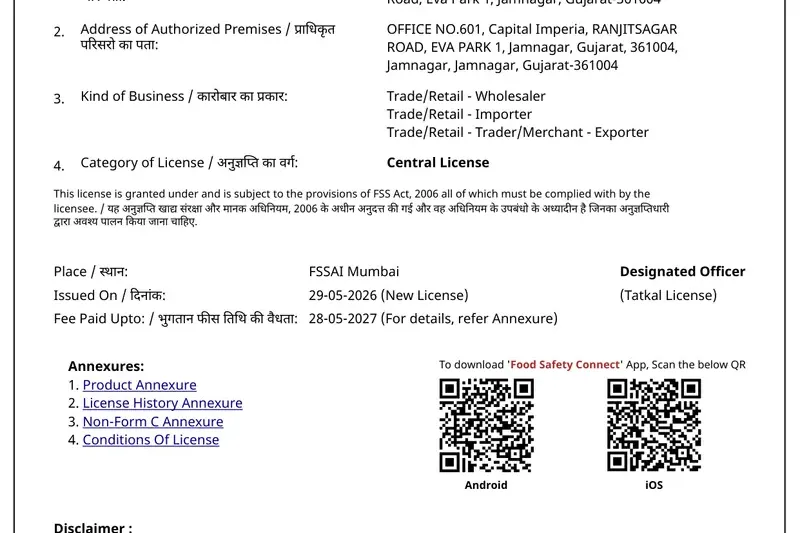
Elysium Agri Corporation, based in Jamnagar, Gujarat, holds FSSAI Central Licence No. 10726998000466, valid to 28 May 2027. We are also registered with DGFT (IEC), APEDA and the Spices Board. Scans of each registration are on our certificates page, and we send the relevant certificates with every quote. Every lot is tested by NABL-accredited labs before loading, as set out on our quality page.
Tell us the product, grade, quantity and destination, and we will send a quote with our certificates attached. Request a product quote →
Frequently asked questions
Is an FSSAI licence mandatory for food exporters?
Yes. FSSAI states that a licence is mandatory for both the export and import of food products. Exporters are listed under the Central Licence with no turnover threshold, so every Indian food exporter needs a central licence. No separate no-objection certificate from food safety officials is needed to export, but the licence itself is required.
What is the difference between FSSAI central and state licences?
A central licence is issued by FSSAI's central authority and covers businesses with turnover above Rs 50 crore, plus all importers and exporters at any turnover. A state licence is issued by the state food safety department for businesses with turnover above Rs 1.5 crore and up to Rs 50 crore that trade within India. Both have 14-digit numbers starting with 1.
What does an FSSAI licence cover for exports?
The licence covers the business, its licensed premises, the kind of business and the food categories it may handle. It confirms the exporter is a legal, inspected food business. It does not certify any single shipment, so each lot still needs a Certificate of Analysis, a phytosanitary certificate, a certificate of origin and any other documents the destination requires.
What documents are needed to apply for an FSSAI central licence?
FoSCoS publishes a Documents Required list for each kind of business. For exporters it usually includes Form B, identity and address proof of the owners or directors, proof of the premises, the business constitution such as a partnership deed, a food safety management plan and the Import Export Code. Manufacturers also submit plant layout and equipment details.
Do importers ask for an FSSAI licence from Indian suppliers?
Yes. Most importers ask for the FSSAI licence as part of supplier approval, together with the IEC, APEDA or Spices Board registration and recent lab reports. They check the 14-digit number on FSSAI's FoSCoS portal, confirm the status is active and make sure the name and address match the exporter's invoice and other registrations.
Related reads


