

On this page
- What Is APEDA?
- What Does APEDA Do for Exporters and Buyers?
- Which Products Are Covered by APEDA?
- Who Needs APEDA Registration?
- How Does APEDA Support Quality and Traceability?
- How Can Buyers Verify APEDA Registration?
- Which Other Registrations Should You Check Alongside APEDA?
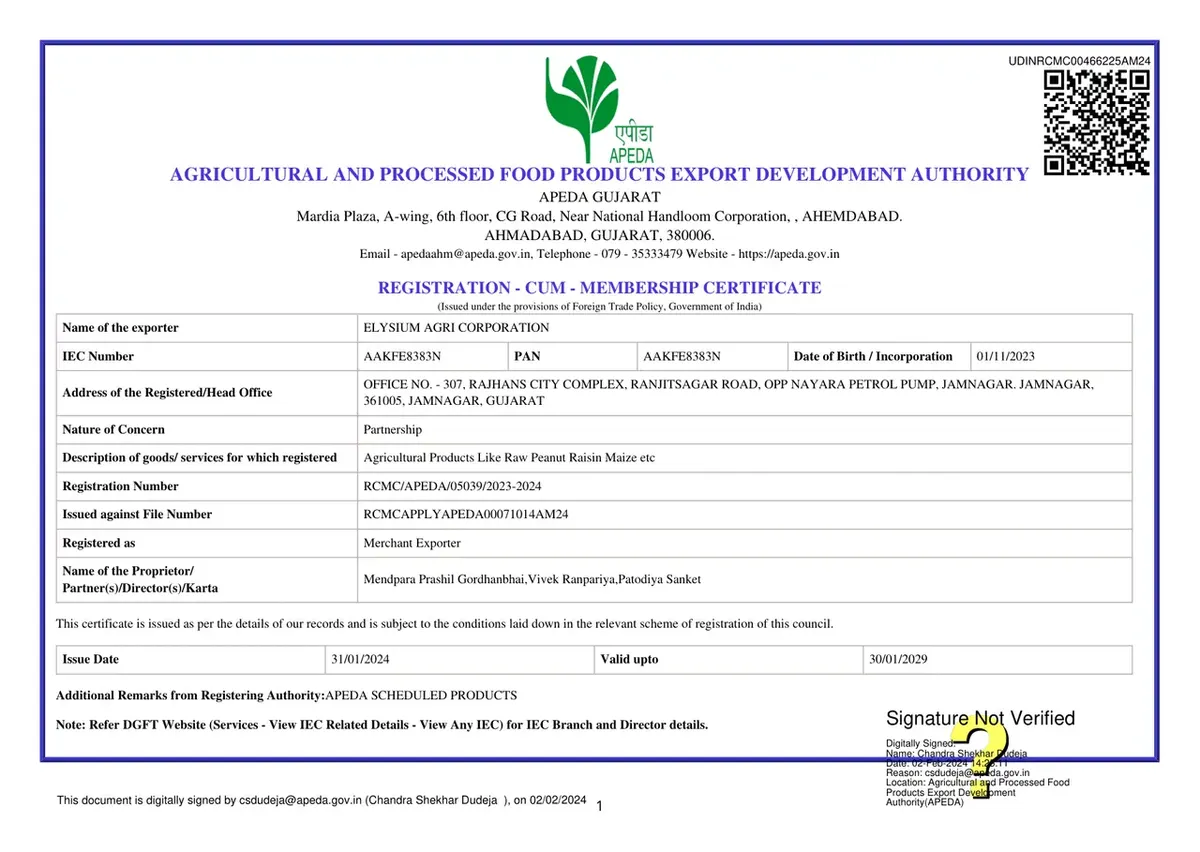
- How Can You Verify Elysium’s APEDA Registration and Export Credentials?
- Frequently asked questions
APEDA is the Agricultural and Processed Food Products Export Development Authority, the Government of India body that registers, regulates and promotes exporters of scheduled agricultural and processed food products. Exporters of these products must register with APEDA and hold its Registration-cum-Membership Certificate (RCMC). For an overseas buyer, an APEDA registration is one of the first credentials to check when you short-list an Indian supplier. This guide explains what APEDA does, which products it covers and how you can verify a registration yourself.
Key takeaways
- APEDA was set up under the APEDA Act, 1985, and works under the Ministry of Commerce and Industry.
- Section 12 of the Act requires every exporter of a scheduled product to register with APEDA.
- A buyer can check an exporter’s APEDA RCMC on the DGFT e-RCMC system or the APEDA exporter directory.
- APEDA registration should be checked together with the IEC, GST, FSSAI and, for spices, Spices Board registrations.
What Is APEDA?
APEDA is a statutory export development authority of the Government of India. It was created by the Agricultural and Processed Food Products Export Development Authority Act, 1985, which came into effect on 13 February 1986. According to APEDA’s own profile, it works under the Department of Commerce in the Ministry of Commerce and Industry.
In simple terms, APEDA is the official link between Indian farm and food exporters and the government. It registers exporters, sets standards for some products, supports quality and traceability systems, and promotes Indian agri-food products in overseas markets. It is not a testing laboratory and it does not certify each shipment. Shipment-level documents, such as phytosanitary certificates, come from other agencies.
What Does APEDA Do for Exporters and Buyers?
APEDA registers exporters, develops the export industry and gives buyers an official record of who is allowed to export scheduled products. The Act lists its functions. They include:
- Registering exporters of scheduled products and issuing the RCMC.
- Fixing standards and specifications for scheduled products for export.
- Inspection of products, processing plants and storage places to ensure quality.
- Improving packaging and marketing of Indian products abroad.
- Promoting export-oriented production and developing the export industry.
- Collecting statistics on production, processing and exports.
- Training in areas connected with scheduled products.
For you as a buyer, the most useful function is registration. A registered exporter has given APEDA its legal and contact details, and its RCMC number can be checked on government systems. APEDA also leads Indian pavilions at international food fairs, where many importers meet their suppliers for the first time.
Which Products Are Covered by APEDA?
APEDA covers the “scheduled products” listed in the First Schedule of the Act. APEDA groups them into the following categories:
- Fruits, vegetables and their products
- Meat and meat products, poultry and poultry products
- Dairy products
- Bakery products, confectionery, biscuits, cocoa and chocolates
- Honey, jaggery and sugar products
- Alcoholic and non-alcoholic beverages
- Cereals and cereal products, including basmati rice
- Groundnuts, peanuts and walnuts
- Pickles and chutneys
- Guar gum, floriculture products, cashew nuts and their products
- De-oiled rice bran and green pepper in brine
Some farm products have their own commodity boards. Spices, for example, come under the Spices Board of India, and tea and coffee have their own boards. A multi-product exporter such as a supplier of peanuts, pulses and spices may therefore hold more than one registration. Many multi-product agri exporters use APEDA as their main export promotion council.
Who Needs APEDA Registration?
Every exporter of a scheduled product needs APEDA registration. Section 12 of the APEDA Act says that every person exporting one or more scheduled products must apply to be registered within one month of starting such exports. The RCMC is also needed to claim export benefits under India’s Foreign Trade Policy. The table summarises common cases.
| Who | APEDA registration needed? | Notes |
|---|---|---|
| Exporter of groundnuts, cereals, fresh produce or processed foods | Yes, mandatory | Scheduled products under the APEDA Act |
| Exporter of basmati rice | Yes, mandatory | Additional APEDA contract registration applies |
| Exporter of de-oiled rice bran | Yes, mandatory | Listed as a scheduled product |
| Exporter of spices only | Not usually | Registers with the Spices Board instead |
| Multi-product agri exporter | Yes, plus other boards | May hold APEDA and Spices Board RCMCs together |
| Overseas importer or buyer | No | APEDA registers Indian exporters only |
To register, an exporter applies online with its Import Export Code (IEC), business details and fee. The RCMC is now handled through the DGFT e-RCMC system, and each certificate carries a number and a validity date. Before you place an order, check that the date has not passed.
How Does APEDA Support Quality and Traceability?
APEDA runs several online traceability and certification systems that link farms, packers, laboratories and export inspection. These systems help Indian products meet the rules of strict markets such as the European Union.
- Peanut.Net: traceability for groundnut exports. For groundnuts to the EU, the health certificate is issued through this system.
- GrapeNet and HortiNet: farm-to-export traceability for grapes and other fresh produce.
- TraceNet: the online system for organic products under India’s National Programme for Organic Production (NPOP), for which APEDA acts as secretariat.
These systems record where a lot came from and which tests it passed. They work alongside an exporter’s own controls, such as lot-wise lab tests and pre-shipment inspection. Our traceability page explains how we link each lot to its source, tests and container.

How Can Buyers Verify APEDA Registration?
You can verify an APEDA registration online in a few minutes. Ask the exporter for its RCMC number, then check it on an official system. Do not rely on a scanned certificate alone, because scans can be edited.
- Get the RCMC number and the company’s legal name and IEC from the exporter.
- Search the record on the DGFT e-RCMC system or the exporter directory on the APEDA website.
- Match the details: company name, IEC, address and the products listed.
- Check the validity date and make sure the certificate has not expired.
- Cross-check the IEC on the DGFT portal and the GSTIN on the GST portal. The names should match your invoice and bank details.
It also helps to know what an APEDA registration does not prove. It shows that the company is a registered exporter with a known legal identity. It does not show that a particular lot meets your specification, that the goods are free of pesticide residues or aflatoxin, or that the company has a good payment and delivery record. Those points need separate evidence: a lot-wise certificate of analysis from an accredited laboratory, a pre-shipment inspection by an independent surveyor, and trade references from other buyers.
A sensible approach is to treat APEDA registration as a minimum entry test. If an exporter of a scheduled product cannot show a valid RCMC, stop there. If it can, move on to the quality and commercial checks. For the first order, many buyers also ask for a type sample and a video call from the warehouse, so they can see the goods and the team before any money is paid.
If any detail does not match, ask the exporter to explain before you pay an advance. Our guide on how to find suppliers in India covers other due-diligence steps.
Which Other Registrations Should You Check Alongside APEDA?
APEDA is one part of an exporter’s credentials. A complete check covers the following registrations:
- Import Export Code (IEC): issued by DGFT. No Indian business can export without it.
- GST registration (GSTIN): confirms the legal entity and its address for tax.
- FSSAI licence: India’s food safety licence. Food exporters need a Central Licence.
- Spices Board registration (CRES): required for spice exporters.
- Destination registrations: for example, FDA food facility registration for food shipped to the USA.
Shipment documents, such as the phytosanitary certificate, the certificate of origin and the certificate of analysis, are separate from these registrations and come with each lot. Our certificates page shows which documents we issue with each product.
Related reading: FSSAI Licence for Export: What Food Exporters Need and Moisture Content in Grains: Safe Levels, Testing and Contracts.
How Can You Verify Elysium’s APEDA Registration and Export Credentials?
Elysium Agri Corporation is registered with APEDA under RCMC number RCMC/APEDA/05039/2023-2024, valid to 30 January 2029. We also hold Import Export Code AAKFE8383N, GSTIN 24AAKFE8383N1ZR, FSSAI Central Licence 10726998000466 and Spices Board registration CRES/SBCB/28692/2026-2027. You can check each number on the official portal yourself.
Our verify Elysium page lists every registration with a link to the portal where you can confirm it. You can also book a video call to see our team, goods and warehouse live. When you are satisfied that our APEDA registration and other credentials are in order, send us your product, grade and destination port. Request an export quote →
Frequently asked questions
What is APEDA?
APEDA is the Agricultural and Processed Food Products Export Development Authority. It was set up by the Government of India under the APEDA Act, 1985, and works under the Ministry of Commerce and Industry. It registers exporters of scheduled agri and food products, sets export standards, supports traceability systems and promotes Indian food products in overseas markets.
What does APEDA do for agricultural exporters?
APEDA registers exporters and issues the Registration-cum-Membership Certificate (RCMC). It also sets standards for some products, runs traceability systems such as Peanut.Net, GrapeNet and TraceNet, supports packaging and market development, collects export statistics, and leads Indian pavilions at international food fairs. The RCMC also lets exporters claim benefits under India's Foreign Trade Policy.
Is APEDA registration mandatory for exporting from India?
Yes, for scheduled products. Section 12 of the APEDA Act requires every person exporting a scheduled product, such as groundnuts, cereals, fresh produce or processed foods, to apply for registration within one month of starting exports. Products covered by other boards, such as spices under the Spices Board, need registration with that board instead.
How can a buyer verify an exporter's APEDA registration?
Ask the exporter for its RCMC number, legal name and IEC. Search the number on the DGFT e-RCMC system or the exporter directory on the APEDA website, and check that the name, address, products and validity date match. Then cross-check the IEC on the DGFT portal and the GSTIN on the GST portal before you pay.
Which products come under APEDA?
APEDA covers the scheduled products in its Act. They include fruits and vegetables, meat and poultry, dairy, bakery products, cocoa and chocolates, honey and sugar products, beverages, cereals including basmati rice, groundnuts and walnuts, pickles and chutneys, guar gum, floriculture, cashew nuts, de-oiled rice bran and green pepper in brine.
Related reads


