
On this page
- What Is Aflatoxin in Feed?
- Why Are Oilseed Meals at Risk?
- How Does Aflatoxin Affect Livestock and the Food Chain?
- What Are the Aflatoxin Limits in Feed by Region and Species?
- How Are Feed Ingredients Sampled and Tested?
- How Can Storage and Handling Limit Contamination?
- What Should You Check in a Supplier’s Test Report?
- How Do You Buy Tested Oilseed Meals from India?
- Frequently asked questions
Aflatoxin in feed is a toxic compound made by Aspergillus moulds that can grow on oilseed meals, maize and other feed ingredients. Most importing countries set a maximum level, such as the EU limit of 20 µg/kg for aflatoxin B1 in feed materials, so every lot should be tested before it ships. Aflatoxin harms animal health and, in dairy cattle, passes into milk. This guide explains the limits, the testing and what to look for in a supplier’s report.
Key takeaways
- Aflatoxin B1 is the most common and most toxic aflatoxin in feed. It forms in warm, humid conditions in the field and in storage.
- Groundnut meal, cottonseed meal, maize and maize by-products such as DDGS carry the highest risk.
- The EU limit is 20 µg/kg in feed materials and 5 µg/kg in compound feed for dairy animals. The US uses action levels from 20 to 300 ppb by species.
- Ask for a lot-wise Certificate of Analysis from an accredited lab that names the method, the sample and the result in µg/kg.
What Is Aflatoxin in Feed?
Aflatoxins are mycotoxins, which are poisons produced by moulds. The main producers are Aspergillus flavus and Aspergillus parasiticus. These moulds infect crops in the field, especially when plants are stressed by heat or drought, and they keep growing if the harvest is stored damp. There are four main types: B1, B2, G1 and G2. Aflatoxin B1 is the most frequent and the most toxic, so feed laws usually set limits for B1 alone.
Aflatoxin cannot be seen, smelled or tasted. It is also heat-stable, so normal pelleting or drying does not remove it. For these reasons, the only reliable control is good handling plus laboratory testing of every lot.
Why Are Oilseed Meals at Risk?
Oilseed meals are at risk because the seeds they come from are often infected before crushing, and the toxin stays in the meal after the oil is removed. Groundnuts grow underground, where soil fungi can reach the pods, and late-season drought raises the risk. Cottonseed and maize are also common hosts.
Solvent extraction takes the oil out but leaves most of the aflatoxin in the solid meal. Because the oil is removed, the toxin is more concentrated per kilogram of meal than in the original seed. The same effect happens in corn DDGS: fermentation uses up the starch, and mycotoxins concentrate in the remaining grain solids, about three times the level in the original maize.
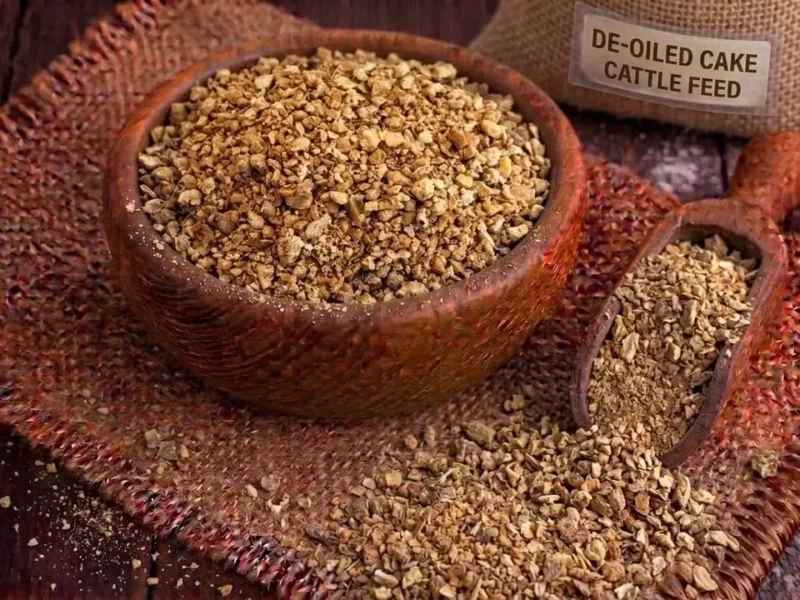
- Higher risk: groundnut de-oiled cake, cottonseed meal, maize and corn DDGS.
- Moderate risk: de-oiled rice bran, millet and sunflower meal, depending on storage.
- Lower risk: soyabean meal and rapeseed meal, although they should still be tested when they are stored in hot, humid conditions.
How Does Aflatoxin Affect Livestock and the Food Chain?
Aflatoxin mainly damages the liver. At lower levels it reduces feed intake, growth and egg or milk yield, and it weakens the immune system. At high levels it can cause acute illness and death. Young animals, poultry (especially ducklings and turkeys) and pigs are among the most sensitive. Ruminants tolerate more, because rumen microbes break down part of the toxin, but they are not immune.
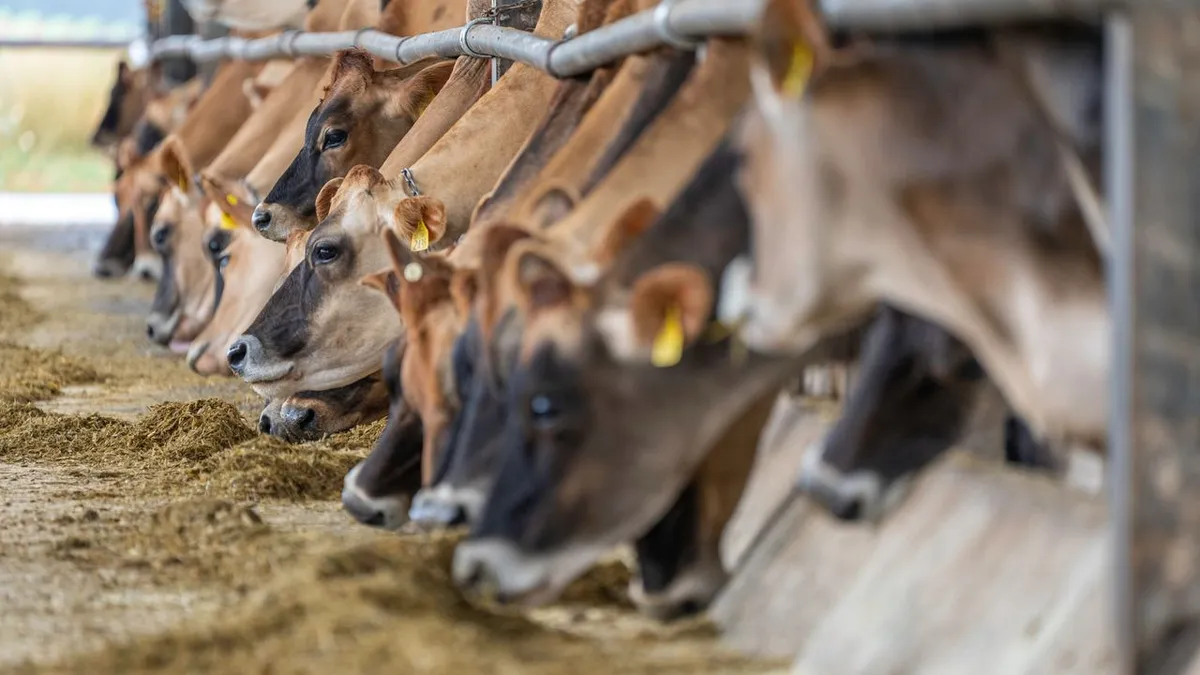
Aflatoxin in cattle feed is a particular concern for dairy farms. When a cow eats aflatoxin B1, her liver converts part of it into aflatoxin M1, which is secreted in milk. A 2023 review of carry-over studies reports that about 1–2% of the B1 in feed reaches milk as M1 on average, and up to 6% in high-yielding cows. M1 survives pasteurisation, so it reaches cheese, yoghurt and milk powder. The EU sets a limit of 0.050 µg/kg of M1 in milk under Regulation (EU) 2023/915. Dairy feed limits are therefore set low to keep milk compliant.
What Are the Aflatoxin Limits in Feed by Region and Species?
Aflatoxin limits in feed depend on the destination market and the animal. The EU sets legal maximum levels for aflatoxin B1 in Directive 2002/32/EC, based on feed at 12% moisture. The UK applies the same levels. The US FDA uses action levels for total aflatoxins in Compliance Policy Guide Sec. 683.100. Many Asian and Middle Eastern buyers set the limit in the contract, often at 50 µg/kg for oilmeals.
| Market | Feed or animal class | Limit |
|---|---|---|
| EU and UK | Feed materials (for example groundnut meal, DDGS, maize) | 20 µg/kg aflatoxin B1 |
| EU and UK | Complementary and complete feed (general) | 10 µg/kg aflatoxin B1 |
| EU and UK | Compound feed for dairy cattle, calves, dairy sheep and goats, lambs, kids, piglets and young poultry | 5 µg/kg aflatoxin B1 |
| EU and UK | Compound feed for other cattle, sheep, goats, pigs and poultry | 20 µg/kg aflatoxin B1 |
| USA | Dairy animals, immature animals, pets and unknown use | 20 ppb total aflatoxins |
| USA | Breeding cattle, breeding swine and mature poultry (corn and peanut products) | 100 ppb |
| USA | Finishing swine of 100 lb or more (corn and peanut products) | 200 ppb |
| USA | Finishing beef cattle (corn and peanut products); cottonseed meal for beef cattle, swine or poultry | 300 ppb |
| Asia and Middle East | Oilmeals by contract | Set by buyer, often 50 µg/kg |
1 µg/kg equals 1 ppb. Always confirm the current limit with your importing authority.
Note the difference between the systems. The EU limits apply to aflatoxin B1, while the US action levels apply to total aflatoxins (B1, B2, G1 and G2).
How Are Feed Ingredients Sampled and Tested?
Feed ingredients are tested by drawing many small samples from across the lot, combining them, grinding them and analysing a portion in a laboratory. Sampling is the biggest source of error. Aflatoxin occurs in “hot spots”, so a few contaminated kernels or lumps can carry most of the toxin. One scoop from the top of one bag can give a false pass or a false fail.
Good practice is to take incremental samples from many bags or points in the lot, mix them into an aggregate sample, and grind the whole sample finely before sub-sampling. In the EU, official feed sampling and analysis follow Regulation (EC) No 152/2009.
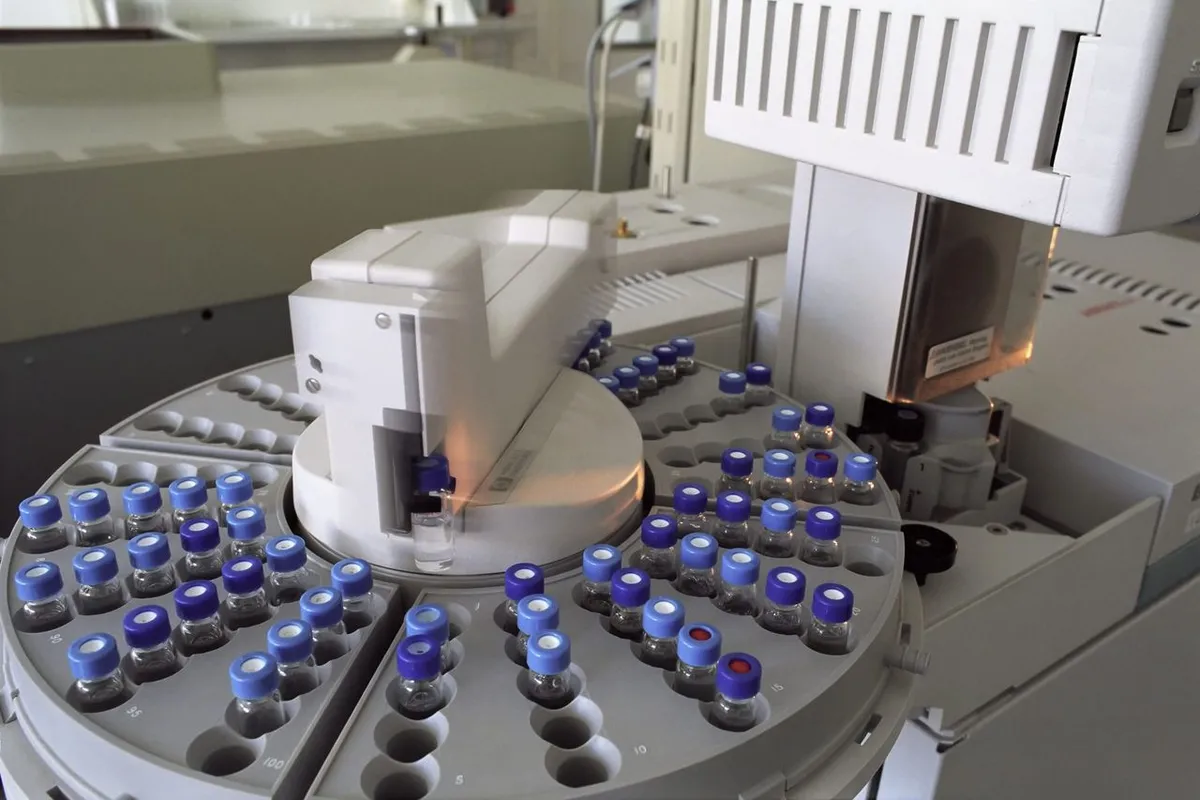
Three groups of test methods are common:
- Rapid tests: lateral flow strips and ELISA kits. They are quick and cheap, and they suit screening at intake, but results should be confirmed for export.
- HPLC with immunoaffinity clean-up: the standard confirmatory method for aflatoxins B1, B2, G1 and G2.
- LC-MS/MS: measures several mycotoxins in one run, and is used by many accredited labs.
How Can Storage and Handling Limit Contamination?
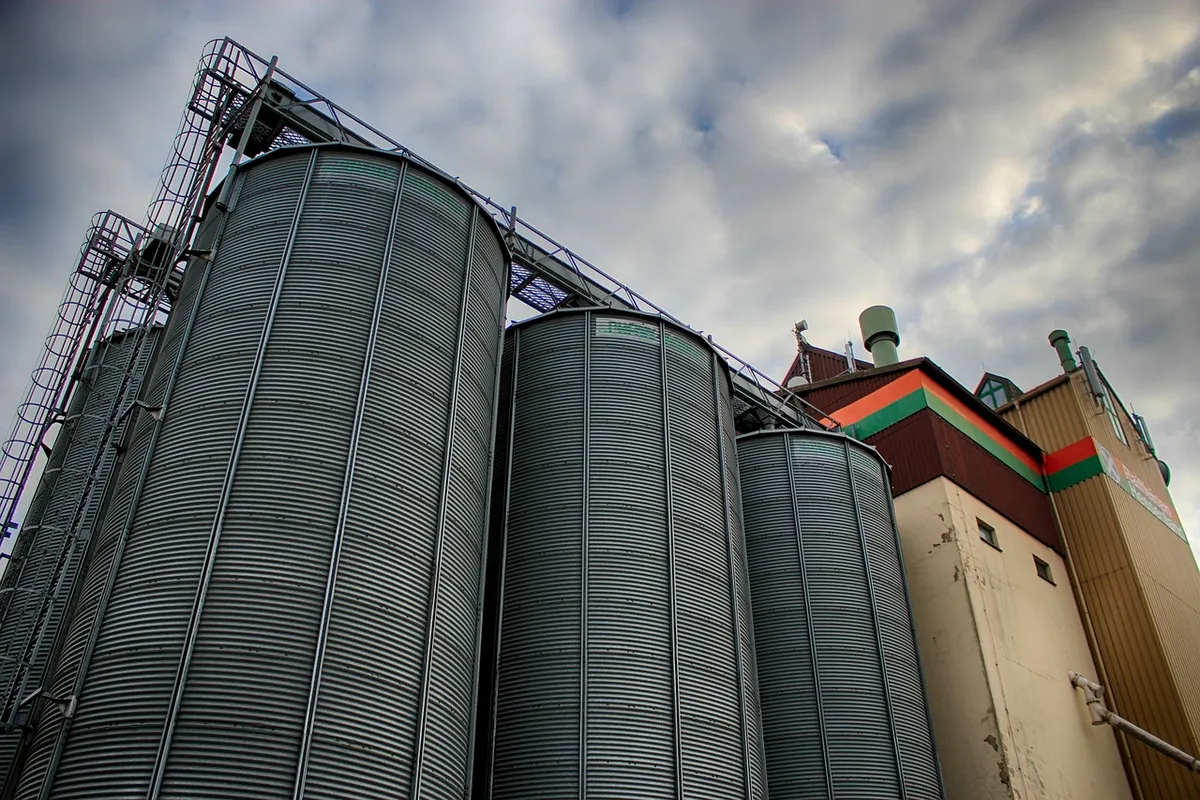
Storage and handling limit aflatoxin by keeping ingredients dry, cool and clean so mould cannot grow. Aflatoxin that is already present cannot be removed by drying, but good storage stops it from increasing. Feed mills and exporters can reduce risk at each step:
- Buy from crops that were dried quickly after harvest, and reject damp or mouldy lots at intake.
- Keep moisture within the specification. Store bags on pallets, away from walls, in a ventilated, covered warehouse.
- Use first-in, first-out stock rotation, and clean bins and silos between lots.
- Control insects and rodents.
- For sea freight, use clean, dry containers with liners and desiccants to reduce condensation on long voyages.
- Where the law allows, a feed mill may use approved mycotoxin binders in compound feed. Binders do not make a non-compliant ingredient legal.
What Should You Check in a Supplier’s Test Report?
A supplier’s test report should prove that the lot you receive meets your limit. A general certificate for the factory or a report from an earlier shipment does not do this. Check these points on each Certificate of Analysis:
- Laboratory: an accredited lab (NABL in India, or ISO/IEC 17025 elsewhere), with its name and accreditation number on the report.
- Sample identity: the lot or batch number, the number of bags and the date of sampling, so the report matches your shipment.
- Who sampled: the exporter, the lab or an independent surveyor such as SGS.
- What was measured: aflatoxin B1 alone, or total aflatoxins, in µg/kg.
- Method and limit of quantification: for example HPLC, with a quantification limit well below your contract limit.
- Other results: moisture, protein, sand and silica, so you can judge the whole lot.
For large or sensitive orders, such as dairy feed for the EU, ask for an independent pre-shipment sample and keep a sealed counter-sample for your own lab.
Related reading: DDGS Feed: Nutrients and Inclusion Rates for Poultry and Cattle and Cotton Seed Oil Cake for Cattle: Protein, Gossypol and Limits.
How Do You Buy Tested Oilseed Meals from India?
To buy oilseed meals with controlled aflatoxin in feed, state your limit, the toxin and the unit in the contract, and ask for a lot-wise report before loading.
Elysium Agri Corporation, based in Jamnagar, Gujarat, exports animal feed ingredients through Kandla and Mundra. These include soyabean meal, rapeseed meal, groundnut DOC, corn DDGS, de-oiled rice bran, millet meal and feed maize. Every lot is tested for protein, fat, fibre, moisture, sand and silica and aflatoxin B1, against your limit, and to the EU level of 20 µg/kg on request. Low-aflatoxin lots of groundnut DOC are available. Our lab testing page explains the test panel, and our registrations are on the certificates page.
Share the ingredient, the protein grade, your aflatoxin limit, the quantity and the destination port, and we will send a specification and price. Request a feed ingredient quote →
Frequently asked questions
What is the aflatoxin limit in animal feed?
It depends on the market and the animal. The EU and UK allow 20 µg/kg of aflatoxin B1 in feed materials and 5 µg/kg in compound feed for dairy animals and young stock. The US FDA uses action levels for total aflatoxins from 20 ppb for dairy and young animals up to 300 ppb for finishing beef cattle.
Which oilseed meals are most prone to aflatoxin?
Groundnut meal and cottonseed meal carry the highest risk, followed by maize and maize by-products such as DDGS. The seeds are often infected before crushing, and the toxin concentrates in the meal once the oil is removed. Soyabean and rapeseed meal are lower risk but should still be tested.
How is aflatoxin tested in feed ingredients?
Many small samples are drawn across the lot, combined, ground and sub-sampled. Rapid strip or ELISA tests are used for screening at intake. Confirmatory results for export come from HPLC with immunoaffinity clean-up or from LC-MS/MS, run by an accredited laboratory and reported in µg/kg.
Why is aflatoxin in cattle feed a concern for milk?
A dairy cow converts part of the aflatoxin B1 she eats into aflatoxin M1, which passes into her milk. Studies report average carry-over of about 1 to 2 percent, and up to 6 percent in high-yielding cows. M1 survives pasteurisation, and the EU limit in milk is only 0.050 µg/kg.
How can feed mills reduce aflatoxin risk in oilseed meals?
Buy lots with a lot-wise test report, test again at intake, and reject damp or mouldy material. Store bags dry, on pallets, in ventilated warehouses, with first-in, first-out rotation. Control pests, clean silos between lots, and use approved binders in compound feed only where the law allows.
Related reads


