
On this page
- 20ft vs 40ft Containers: What Is the Quick Answer?
- What Are the Internal Dimensions and Payload Limits?
- Why Does Bulk Density Decide the Container Size?
- How Do Weight Limits and Route Restrictions Affect the Load?
- Which Commodities Suit 20ft and Which Suit 40ft?
- How Do Cost per Tonne and Booking Compare?
- How Can You Plan Your Container Load with Elysium?
- Frequently asked questions
In the 20ft vs 40ft container choice, the 20 ft is usually cheaper for dense agri cargo such as pulses, wheat and maize, because a 40 ft cannot legally carry much more weight. For light cargo such as spices, seeds and dehydrated vegetables, a 40 ft high cube usually gives the lowest freight cost per tonne. Both boxes can carry about 28 tonnes of cargo, but a 40 ft has twice the space. This guide explains the dimensions, payloads, road limits and costs so you can pick the right size for each order.
Key takeaways
- A 20 ft dry container has about 33 m³ of space and about 28.1 t of payload. A 40 ft high cube has about 76 m³ but only about 28.6 t of payload.
- Bulk density decides the size: pulses and grains fill a 20 ft by weight, while seeds and spices fill it by space.
- Road limits at the destination can lower the real load, for example to about 20 MT in a 20 ft in the USA.
- Compare freight per tonne, not per container, before you book.
20ft vs 40ft Containers: What Is the Quick Answer?
Choose a 20 ft container for heavy, dense cargo and a 40 ft (usually a 40 ft high cube) for light, bulky cargo. That one rule covers most agri shipments from India.
The reason is simple. Every container has two limits: how much weight it can carry and how much space it has. A 40 ft container has about twice the space of a 20 ft, but its maximum payload is only a few hundred kilograms higher. So if your cargo reaches the weight limit in a 20 ft, a 40 ft gives you almost no extra tonnes, and you pay more freight for the same load. If your cargo fills the space of a 20 ft long before it reaches the weight limit, a 40 ft lets you ship far more tonnes in one box.
Most bagged agri cargo from India ships in 20 ft containers. The 40 ft high cube is the better choice for light products and for large orders of medium-density products such as sesame and peanut kernels.
What Are the Internal Dimensions and Payload Limits?
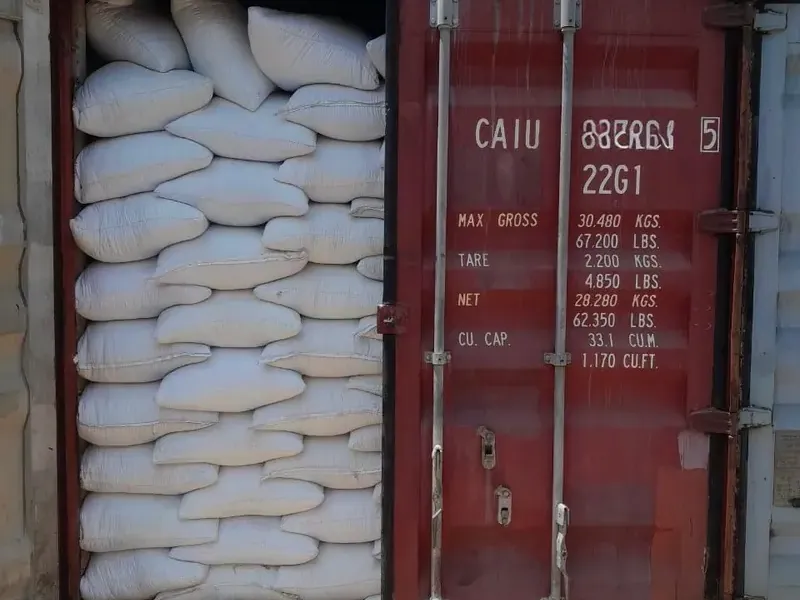
The table shows the standard dry container sizes, based on Hapag-Lloyd and Maersk specifications as published on our container load calculator. Payload varies a little between boxes, and the exact tare weight is printed on each container door.
| Specification | 20 ft standard | 40 ft standard | 40 ft high cube |
|---|---|---|---|
| Internal length × width × height | 5.90 × 2.35 × 2.39 m | 12.03 × 2.35 × 2.39 m | 12.03 × 2.35 × 2.70 m |
| Door opening (W × H) | 2.34 × 2.29 m | 2.34 × 2.29 m | 2.34 × 2.60 m |
| Internal volume | ≈ 33 m³ | ≈ 67–68 m³ | ≈ 76 m³ |
| Tare weight | ≈ 2,280–2,350 kg | ≈ 3,700–3,750 kg | ≈ 3,880–3,900 kg |
| Max gross weight | 30,480 kg | 32,500 kg | 32,500 kg |
| Max payload | ≈ 28,100–28,200 kg | ≈ 28,750–28,800 kg | ≈ 28,600 kg |
| Typical bagged agri load | 9–26 MT (by product) | 18–28 MT | 14–28 MT |
Standard dry container specifications. Payload differs slightly between carriers and boxes.
A 40 ft high cube is about 30 cm taller inside than a standard 40 ft. For bagged agri cargo this extra height adds roughly 8 to 9 m³ of space, which is why light products almost always go in high cubes rather than standard 40 ft boxes.
Why Does Bulk Density Decide the Container Size?
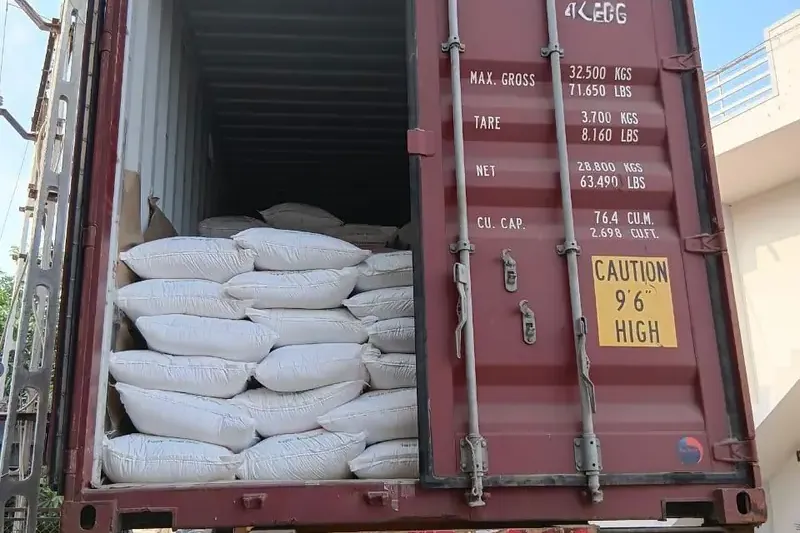
Bulk density tells you whether your cargo will run out of weight or space first. It is the weight of one cubic metre of product as packed, in kg/m³.
As a rule of thumb, cargo denser than about 850 kg/m³ is weight-limited in a 20 ft container. Pulses, wheat and maize are about 750 to 850 kg/m³ in bags, so they reach the weight limit at 24 to 26 MT in a 20 ft, before the box is full. Sesame, peanut kernels and spices are lighter and fill the space first, at 13 to 19 MT. Dehydrated onion flakes and psyllium husk are so light that a 20 ft holds only 6 to 10 MT.
You can work out the likely load yourself: multiply the usable volume by the bulk density, then compare the result with the payload. The lower of the two numbers is your load. Our calculator does this for more than 60 products, or you can enter your own bag size and weight.
How Do Weight Limits and Route Restrictions Affect the Load?
The practical weight limit is often set on the road at the destination, not by the ship or the container. Trucks must carry the container, chassis and cargo within local axle and gross weight rules.
- USA: the federal gross vehicle weight limit is 80,000 lb (36.3 t). On a standard chassis, a 20 ft container is often limited to about 20 MT of cargo. Overweight permits vary by state.
- EU (most countries): 40 t for a standard five-axle truck and 44 t for trucks with more than five axles. Usually the container payload is the real limit.
- Other markets: rules vary, so ask your clearing agent or haulier before you fix the quantity.
Shipping lines can also set their own weight caps on some routes or vessels, and every container needs a verified gross mass (VGM) declared before loading. If you plan a heavy 20 ft load, confirm the limit with the carrier when you book.
Which Commodities Suit 20ft and Which Suit 40ft?
Dense commodities suit 20 ft containers, and light or medium-density ones suit 40 ft high cubes. The typical loads below come from our own shipments in the usual export packs.
| Product | 20 ft load | 40 ft load | Limited by | Usual choice |
|---|---|---|---|---|
| Kabuli and desi chickpeas | ≈ 24–25 MT | ≈ 26–28 MT (HC) | Weight | 20 ft |
| Green moong and urad | ≈ 24–26 MT | ≈ 26–28 MT (HC) | Weight | 20 ft |
| Fenugreek seeds | ≈ 22–24 MT | ≈ 27–28 MT | Weight | 20 ft |
| Peanut kernels (bold, Java, TJ) | ≈ 19 MT | ≈ 26–27 MT (HC) | Volume | Either |
| Natural sesame seeds | ≈ 19 MT | ≈ 25–27 MT | Volume | Either |
| Cumin seeds | ≈ 13–14 MT | ≈ 26–28 MT | Volume | 40 ft HC |
| Coriander seeds | ≈ 9–10 MT | ≈ 18–21 MT | Volume | 40 ft HC |
| Psyllium husk | ≈ 9–9.5 MT | ≈ 20 MT (HC) | Volume | 40 ft HC |
Typical net loads in metric tonnes. We confirm the exact load on every quote.
If you need several products but not a full box of each, a mixed container can help. Pair dense and light products so that the box reaches both its space and weight limits together. Our guide to mixed container shipping from India explains how.
How Do Cost per Tonne and Booking Compare?
Compare freight per tonne, not per container. A 40 ft box costs more to ship than a 20 ft, but usually much less than two 20 ft boxes. Whether it saves money depends on how many extra tonnes it lets you carry.
Take cumin as an example. A 20 ft carries about 13 to 14 MT, and a 40 ft high cube about 26 to 28 MT. The 40 ft carries roughly twice the cargo for less than twice the freight, so its cost per tonne is lower. For chickpeas, the 20 ft already carries 24 to 25 MT, and the 40 ft adds only a few tonnes, so the 20 ft is cheaper per tonne.
Also consider:
- Destination charges: terminal handling, delivery and detention charges are often set per container, so fewer boxes can save money at your end.
- Warehouse space: a 40 ft delivers twice the volume at once. Make sure you can unload and store it.
- Equipment availability: 20 ft boxes are common at Indian ports, but on some routes and in some months one size is easier to book than the other.
- Incoterm: under FOB you book the freight, while under CFR or CIF the exporter does. See FOB vs CIF for agri imports.
Our landed cost calculator helps you compare the full cost per tonne, including freight, duty and local charges.
Related reading: Mundra Port: Location, Facilities and Agro Export Routes and Cash Against Documents vs LC vs TT: Export Payment Terms Compared.
How Can You Plan Your Container Load with Elysium?
The 20ft vs 40ft container decision comes down to your product’s density, your destination’s road rules and the freight per tonne on your route. We help you get all three right before you place the order.
Elysium Agri Corporation ships peanuts, sesame, spices, pulses, grains and dehydrated vegetables from Jamnagar, Gujarat, in both 20 ft and 40 ft high cube containers. We confirm the exact load, bag count and packing on every quote, and we can quote FOB, CFR or CIF. See our packaging options, our infrastructure and how we control quality at loading.
Tell us the product, quantity and destination port, and we will recommend the right container and send a price. Request a container load quote →
Frequently asked questions
How much cargo fits in a 20ft container?
A 20 ft dry container has about 33 m³ of space and a maximum payload of about 28 tonnes. In practice it holds 24 to 26 MT of pulses or grains, about 19 MT of sesame or peanut kernels, 13 to 15 MT of cumin or fennel and only 6 to 10 MT of very light products.
Is a 40ft container cheaper per tonne than a 20ft?
It depends on the cargo. For light products such as spices, seeds and dehydrated vegetables, a 40 ft high cube carries roughly twice the tonnes for less than twice the freight, so it is cheaper per tonne. For dense cargo such as pulses and grains, a 20 ft is usually cheaper.
What is the maximum payload of a 20ft container for grains and seeds?
The container's own payload is about 28,100 to 28,200 kg. Grains and pulses usually load 24 to 26 MT in bags, and seeds such as sesame about 19 MT because they fill the space first. Road rules can lower this, for example to about 20 MT in the USA.
When should I choose a 20ft container over a 40ft?
Choose a 20 ft when your cargo is dense and reaches the weight limit before the box is full, as with chickpeas, lentils, wheat and maize. A 20 ft also suits smaller orders, trial shipments and destinations with strict road weight limits or limited warehouse space.
What is a 40ft high cube container?
A 40 ft high cube is a 40 ft dry container about 30 cm taller than standard, with an internal height of about 2.70 m and around 76 m³ of space. Its payload is similar to a standard 40 ft, so it is used mainly for light, bulky cargo such as spices and seeds.
Related reads


