
On this page
- What Does Sesame Seed Purity Mean?
- What Are the Common Sesame Purity Grades?
- 99.95% vs 99.98%: What Is the Real Difference?
- How Is Purity Tested: Sampling and Sortex Checks?
- What Other Specification Points Matter: Moisture, Oil and Free Fatty Acids?
- Which Purity Grade Fits Which Buyer?
- How Do You Buy Hulled and Natural Sesame in Bulk from India?
- Frequently asked questions
A sesame seed specification is built around the purity grade, which states the share of clean, correct-colour seeds by weight, such as 99/1 or 99.95%, plus limits for moisture, oil, free fatty acids and food safety. A 99.95% grade means no more than 0.05% admixture. Purity decides the price, the cleaning method and the end use. This guide explains the common grades, how purity is tested and which grade fits which buyer.
Key takeaways
- Grades from 95/5 to 99/1 are machine-cleaned and suit crushing, hulling and general trade.
- Grades of 99.90% and above need sortex (optical colour) cleaning and are bought by food processors.
- The gap between 99.95% and 99.98% is small by weight but visible in tahini colour and premium bakery.
- A full sesame seed specification also covers moisture, oil, free fatty acids, Salmonella, ethylene oxide and aflatoxin.
What Does Sesame Seed Purity Mean?
Sesame seed purity is the percentage, by weight, of clean seeds of the stated colour in a lot. The rest is called admixture. It includes other-colour seeds (brown or black seeds in a white lot), foreign matter such as dust, stones, stalks and husk, and seeds of other plants.
Grades are written in two ways. A ratio such as 99/1 means 99% white seeds and 1% other-colour seeds or admixture. A single figure such as 99.95% means the lot is 99.95% pure, with 0.05% admixture at most. Higher purity needs more cleaning, more seed rejected and more time, so each step up the grade scale costs more.
There is no single global standard for sesame. Codex has no standard for sesame seeds, and India’s FSSAI has no separate whole-seed standard. In practice, purity grades are set by trade custom and by the contract between buyer and seller. India’s AGMARK grades are also used as a benchmark. For example, AGMARK sets foreign matter at 0.5% maximum and immature or shrivelled seeds at 1% maximum for its Special grade, and moisture at 6% maximum for its Good grade.
What Are the Common Sesame Purity Grades?
Indian sesame is traded in a ladder of grades, each linked to a cleaning method and a typical buyer. The table shows the grades we supply.
| Grade | Meaning | Cleaning | Typical buyer |
|---|---|---|---|
| 95/5, 98/2 | 95–98% white seeds; 2–5% other-colour seeds | Machine-cleaned | Oil crushers |
| 99/1 | 99% white seeds; 1% other-colour seeds | Machine-cleaned | Bakery, traders, hulling plants |
| 99.90% | 0.10% max admixture | Sortex | Food processors |
| 99.95% | 0.05% max admixture | Sortex | EU, Korea and Japan food buyers; standard hulled grade |
| 99.97% (hulled) | 0.03% max admixture | Hulled, then sortex | Premium bakery and confectionery |
| 99.98% | 0.02% max admixture | Double sortex | Tahini and EU or US bakery |
Typical Indian sesame grades. Your contract specification applies.
Natural (unhulled) sesame is usually sold from 99/1 to 99.95%, with 98/2 and 95/5 for crushing. Hulled sesame starts at 99.95% and goes up to 99.98%, because hulled seed is used where appearance matters most.
The cleaning method explains most of the price gap between grades. Machine cleaning uses sieves, aspirators and destoners to remove dust, stones and light material by size and weight. It reaches 99/1 but cannot pick out a seed of the wrong colour. Sortex machines use cameras and air jets to reject each off-colour or defective seed, which is how lots reach 99.90% and above. Double sortex passes the seed through the sorter twice.
99.95% vs 99.98%: What Is the Real Difference?
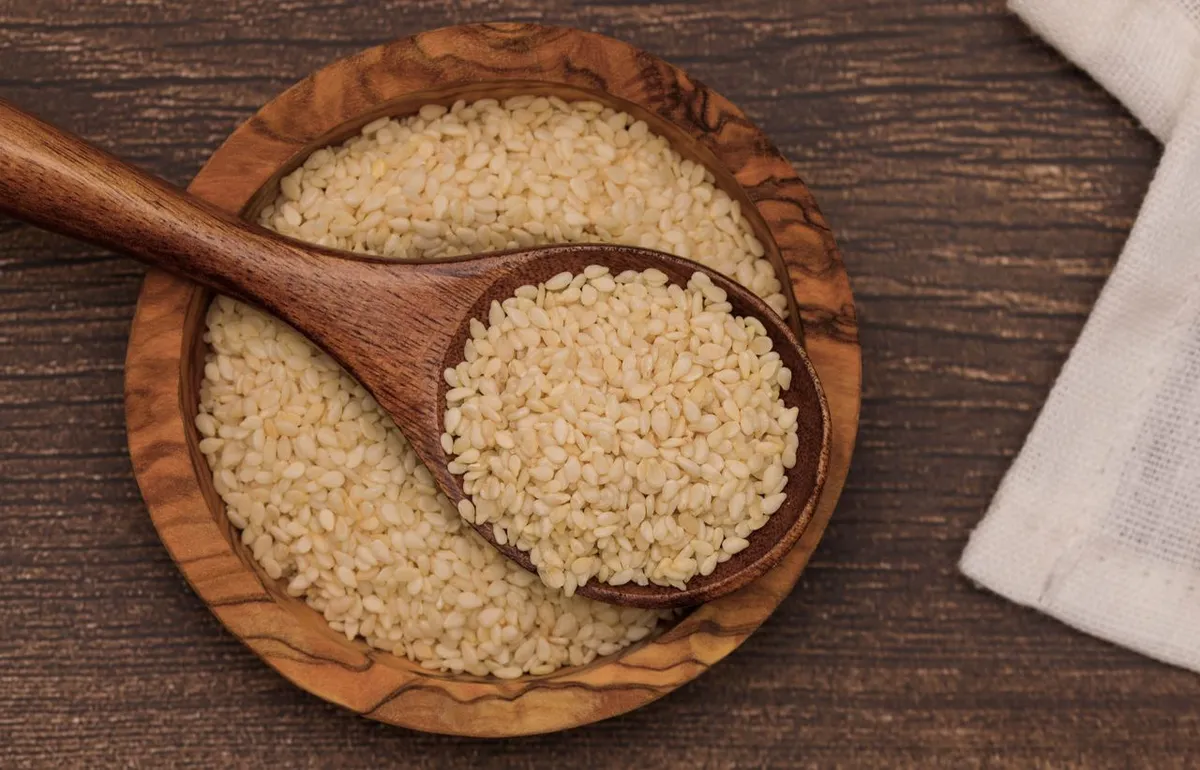
The real difference is 0.03% admixture, which sounds small but matters in some products. A 99.95% lot may contain up to 500 g of admixture per tonne. A 99.98% lot may contain up to 200 g per tonne. In a 19 MT container, that is a gap of up to about 5.7 kg of off-colour seeds and foreign matter.
For bread toppings, halva and most food processing, 99.95% is the standard and works well. For light tahini, a few dark seeds can show as specks or darken the paste. For premium buns and bagels in Europe and the USA, buyers inspect the topping closely. These buyers pay more for 99.98%, which is double sortex-cleaned to remove the last off-colour seeds.
For hulled sesame, buyers often also limit black seeds, for example to no more than 5 per 100 g, and unhulled or off-colour seeds to 1% maximum. These counts are agreed in the contract. They are often more useful than the purity figure alone, because they describe what the end user actually sees.
How Is Purity Tested: Sampling and Sortex Checks?
Purity is tested by drawing a representative sample from the lot, separating the admixture from the clean seed and weighing both. The method follows ISO 658 for impurities in oilseeds. The result is reported as a percentage by weight.
- Sampling: small samples are drawn from many bags across the lot and combined, so the test sample reflects the whole lot.
- Separation: the working sample is spread out and checked by eye and with sieves. Foreign matter, other-colour seeds, damaged seeds and immature seeds are picked out.
- Weighing: each fraction is weighed and expressed as a percentage of the sample.
- Counts: for hulled sesame, black seeds and unhulled seeds are also counted per 100 g.
Sortex cleaning itself is checked during production. Operators test the rejected and accepted streams at regular intervals and adjust the camera settings. Many buyers also appoint an inspection agency, such as SGS, to draw samples at stuffing and confirm the grade before the container is sealed. Our quality page explains our checks.
What Other Specification Points Matter: Moisture, Oil and Free Fatty Acids?
Purity is only one line in a full sesame seed specification. Moisture, oil content and free fatty acids decide how well the seed keeps and how it performs in your plant.
- Moisture: 6% max for natural sesame and 5% max for hulled. Higher moisture raises the risk of mould and rancidity.
- Oil content: 48% minimum, and typically 48–52% for natural sesame. Oil millers and tahini makers watch this figure closely.
- Free fatty acid (FFA): 1.5% max for sortex natural sesame, 2% max for machine-cleaned, and 1.0–1.5% max for hulled. Low FFA means fresh oil and a clean taste.
- Food safety: Salmonella absent in 25 g, ethylene oxide below the EU limit of 0.05 mg/kg, pesticides within the destination’s limits, and aflatoxin B1 ≤ 2 and total ≤ 4 µg/kg for the EU.
Our lab testing page lists the methods. For more on microbial risk, read our guide to Salmonella in sesame and spices.
Which Purity Grade Fits Which Buyer?
Choose the lowest grade that meets your product’s needs. Paying for higher purity than your process needs adds cost without benefit. If your process includes its own cleaning, hulling or crushing, a lower grade is often the better buy. If the seed goes straight onto a consumer product, pay for the higher grade and approve a sample first.
- Oil crushers: 95/5 or 98/2 natural sesame. Oil content matters more than colour.
- Hulling plants and traders: 99/1 natural sesame, which is cleaned again after hulling.
- Bakeries and snack makers: 99.90% or 99.95% natural, or 99.95% hulled for white toppings.
- Tahini and halva makers in the Middle East: hulled 99.95% as standard, and 99.98% for light premium tahini.
- EU, Korean and Japanese food buyers: sortex 99.95% as a minimum, with tight pesticide and ethylene oxide screens.
- Premium bakery in Europe and the USA: hulled 99.97% or 99.98%.
Related reading: Does Sesame Seeds Go Bad? Shelf Life and Storage Guide.
How Do You Buy Hulled and Natural Sesame in Bulk from India?
Elysium Agri Corporation exports natural sesame, hulled sesame and black sesame from Jamnagar, Gujarat. We supply machine-cleaned grades from 95/5 to 99/1 and sortex grades up to 99.98%. Every lot is tested for Salmonella, ethylene oxide, pesticide residues and aflatoxin at an NABL-accredited lab. A 20 ft container holds about 19 MT and a 40 ft about 25–27 MT.
We state the crop year, origin, grade and cleaning method on every contract, and we send a type sample before you book and a pre-shipment sample with the lab report before loading. Send us your sesame seed specification and we will quote grade for grade. Our guide on how to import sesame seeds from India covers documents, shipping and payment terms. Request a sesame quote →
Frequently asked questions
What does 99.95% purity mean for sesame seeds?
It means that at least 99.95% of the lot, by weight, is clean seed of the stated colour, and no more than 0.05% is admixture such as other-colour seeds, dust, stones or husk. That is a maximum of 500 g of admixture per tonne. Reaching this grade requires sortex optical colour cleaning, and it is the standard grade for many food buyers.
How is sesame seed purity tested?
A representative sample is drawn from many bags across the lot. The working sample is spread out and the foreign matter, other-colour seeds, damaged and immature seeds are separated by eye and with sieves. Each fraction is weighed and reported as a percentage of the sample, following ISO 658 for impurities in oilseeds.
What is the difference between 99.95% and 99.98% sesame?
The difference is 0.03% admixture: up to 500 g per tonne for 99.95% against up to 200 g per tonne for 99.98%. The 99.98% grade is double sortex-cleaned to remove the last off-colour seeds. It is preferred for light tahini and premium bakery in Europe and the USA, where dark specks are easy to see.
What impurities are found in natural sesame seeds?
Natural sesame can contain other-colour seeds such as brown or black seeds, dust and sand, small stones, stalks and husk, seeds of other plants, and damaged, discoloured or immature sesame seeds. Machine cleaning removes most foreign matter, and sortex colour sorting removes the remaining off-colour and defective seeds for higher grades.
Which sesame purity grade do buyers in the Middle East and Europe ask for?
Middle East tahini and halva makers usually buy hulled sesame at 99.95%, with 99.98% for light premium tahini. European food buyers usually ask for sortex 99.95% as a minimum, and premium bakeries often ask for hulled 99.97% or 99.98%. Both regions also require tested Salmonella, ethylene oxide and pesticide results.
Related reads


