
On this page
The four main types of lentils are red, green, brown and black. Red lentils are usually sold split and dehulled and cook quickly into a soft purée, while green, brown and black lentils are usually sold whole and keep their shape when cooked. All are seeds of the same plant, Lens culinaris, but they differ in seed coat colour, size, cooking time and end use. This guide compares the lentil varieties and explains how to choose the right one for your product or market.
Key takeaways
- Red, green, brown and black lentils are colour and size types of one species, Lens culinaris.
- Split red lentils cook in about 10–15 minutes; whole green, brown and black lentils take about 20–30 minutes.
- India grows mainly red lentils (masoor); most of the world’s green lentils come from Canada.
- Black lentils (beluga) are not urad dal. Urad is black gram, a different plant.
What Are the Main Types of Lentils?
Lentils are grouped by the colour of their seed coat and their inside (cotyledon), and by size. The four main types in trade are red, green, brown and black.
Lentils are pulses: the dried edible seeds of a legume. The lentil plant is a short annual grown in cool seasons. In India it is a rabi crop, sown in October and November and harvested from February to April. Canada and Australia are the largest exporters, and their harvests set world prices. India is the world’s largest consumer and a major importer, as well as a grower of red lentils.
According to the Harvard T.H. Chan School of Public Health, whole lentils with their seed coats take longer to cook and keep their shape, while split lentils cook quickly and break down into a purée. This single difference explains most of how each type is used.
You may also see other names in trade and retail. “Yellow lentils” are usually green lentils with the seed coat removed, showing the yellow inside. Spanish pardina lentils are a small brown type. “Masoor” is the Hindi name for the red lentil in all its forms, and “malka” is a common trade name for red split lentils. When a buyer and a seller use different names, the safest approach is to agree the colour, size range and form in writing, with a sample.
What Are Red Lentils?
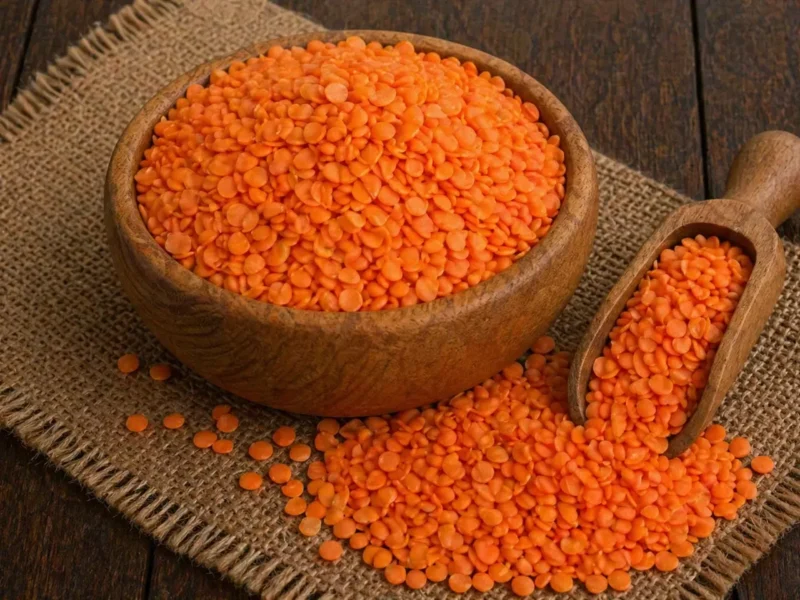
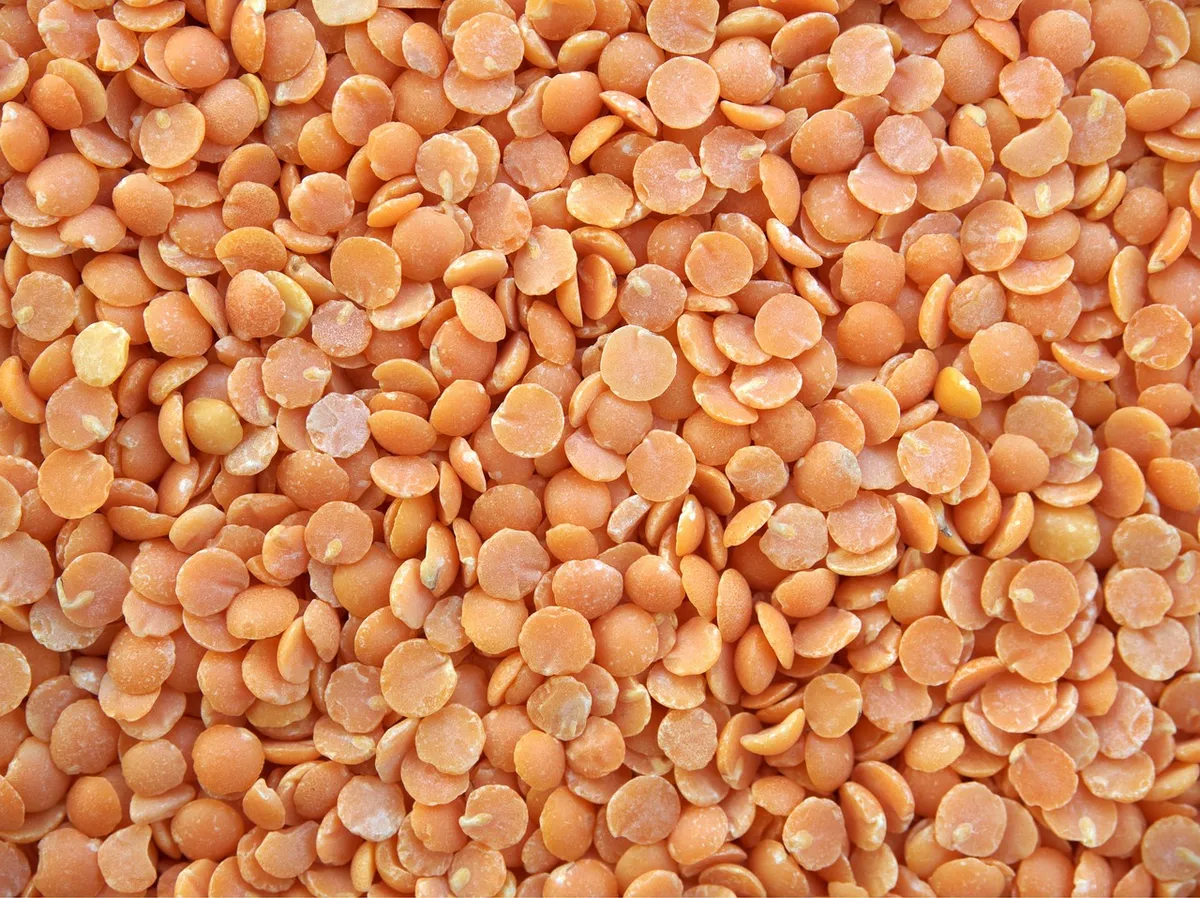
Red lentils have a brown or grey-green seed coat and an orange-red inside. They are usually sold dehulled, either split or whole, which is why they look red or orange in the bag.
- Whole masoor: the whole lentil with its brown seed coat.
- Red split lentils (masoor dal, malka): dehulled and split into halves. They cook fastest.
- Football lentils: dehulled but whole and round.
About 90–95% of red lentils are sold dehulled, as football or split. Split red lentils cook in about 10–15 minutes and break down into a thick purée, which suits dal, soups, purées, baby food and lentil flour. They are the most widely traded lentil in South Asia, the Middle East and North Africa.
What Are Green Lentils?
Green lentils have a green seed coat and a yellow inside. They are sold whole and hold their shape well when cooked, so they suit soups, salads and stews.
Green lentils are traded by size class, named after Canadian varieties:
- Large (Laird type): about 6–7 mm.
- Medium (Richlea type): about 5.5–6 mm.
- Small (Eston type): about 4.5–5.5 mm.
Most of the world’s green lentils are grown in Canada, and India imports them. French green lentils, such as the protected Puy lentil, are a small, dark, speckled type valued for their firm texture.
What Are Brown Lentils?
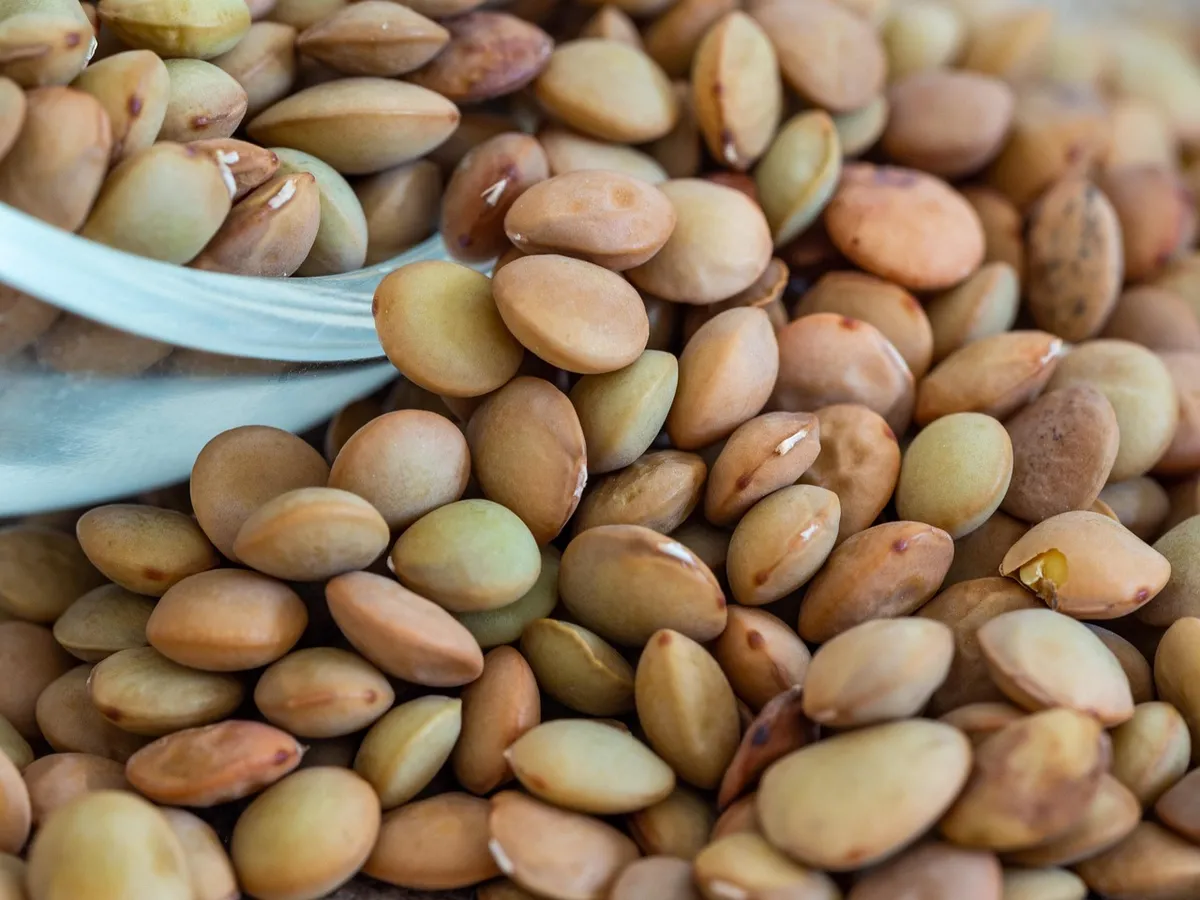
Brown lentils are whole lentils with a khaki to brown seed coat. They are the most common type on supermarket shelves in many Western countries.
Brown lentils have a mild, earthy flavour and a soft texture. They keep their shape if cooked carefully but turn soft if overcooked, which makes them flexible for soups, stews, veggie burgers and casseroles. Whole masoor, the unhulled form of the red lentil, has a brown seed coat and is often used in the same way. In trade, the line between brown and green lentils is not always sharp, so specify the size, colour and variety on your order.
What Are Black Lentils?
Black lentils, often called beluga lentils because they look like caviar, are small, shiny and black. They are whole lentils with a firm texture and keep their shape very well.
Black lentils are a premium product used in salads, side dishes and restaurant cooking. They are mainly grown in Canada and the USA, and they cost more than common green or red lentils.
Black lentils are not the same as urad dal. Urad, or black gram, is Vigna mungo, a different plant from the lentil. Whole urad also has a black skin, but inside it is white, and it is the pulse used for idli, dosa and dal makhani. Our guide to types of dal explains urad and the other Indian dals.
How Do the Lentil Types Compare?
| Type | Usual form | Colour (coat / inside) | Cooking time | Texture when cooked | Best uses |
|---|---|---|---|---|---|
| Red (split) | Dehulled, split | – / orange-red | About 10–15 min | Breaks down to purée | Dal, soups, purées, flour |
| Red (football) | Dehulled, whole | – / orange-red | Slightly longer than split | Soft | Soups, dal, ready meals |
| Green | Whole | Green / yellow | About 20–30 min | Holds shape | Salads, soups, stews |
| Brown | Whole | Khaki-brown / yellow or orange | About 20–30 min | Soft, holds shape if not overcooked | Soups, stews, burgers |
| Black (beluga) | Whole | Black / yellow | About 20–30 min | Firm, holds shape well | Salads, side dishes |
Types of lentils compared. Cooking times are for unsoaked lentils and vary with size and age.
All lentils share the same HS heading, 0713 40, which makes customs classification simple. Older lentils take longer to cook, so freshness matters for canners and ready-meal makers.

How Do You Choose the Right Lentil for Your Product?
Choose by how the lentil must behave in your product. If it must dissolve, choose split red lentils. If it must stay whole, choose green, brown or black lentils.
- Dal, soups and purées: red split lentils for speed and smooth texture.
- Canned and ready meals: green or brown lentils that survive retort cooking; football red lentils where a softer texture is wanted.
- Salads and premium retail: black or small green lentils for firm, attractive whole seeds.
- Flour and protein ingredients: red lentils, which mill into a pale, mild flour.
- Ethnic retail: whole masoor and masoor dal for South Asian shoppers.
Check quality as well as type. Export lentils typically have 99% purity, moisture of 12–13% max, foreign material of 0.2–0.5% max and damage of 2–3.5% max, in line with Canadian No. 1–2 grades. Lentils must also meet the EU glyphosate limit of 10 mg/kg and limits for lead and cadmium.
Origin and timing also shape the choice. Indian red lentils (masoor) are harvested in Uttar Pradesh, Madhya Pradesh and Bihar in the rabi season, while the Canadian harvest in Saskatchewan sets world prices for both red and green lentils. India also levies a 10% duty on lentil imports (since March 2025), which affects the cost of lentils milled in India from imported seed. Ask your supplier to state the origin of every lot on the contract.
Related reading: Mung Beans Size and Grades Explained for Bulk Buyers.
How Can You Buy Lentils in Bulk from India?
Whichever of the types of lentils you need, state the type, size, form, origin and grade on your order, and ask for a lot-wise test report.
Elysium Agri Corporation exports red lentils as whole masoor, red split lentils and football lentils, and supplies green lentils in large, medium and small sizes. Every lot is sortexed and tested for moisture, admixture, pesticides including glyphosate, and heavy metals, and we state the origin of every lot on the contract. Lentils are dense, so a 20 ft container holds about 24–26 MT, and we can combine lentils with other pulses in one container. Plan your load with the container load calculator.
Tell us the lentil type, size, quantity and destination port for a price and specification sheet. Request a lentil quote →
Frequently asked questions
What are the four main types of lentils?
The four main types of lentils are red, green, brown and black. All come from the same plant, Lens culinaris, but differ in seed coat colour, size and cooking behaviour. Red lentils are usually sold split and dehulled, while green, brown and black lentils are usually sold whole and keep their shape.
What is the difference between red and brown lentils?
Red lentils are usually dehulled, showing their orange-red inside, and split red lentils cook in about 10 to 15 minutes into a soft purée. Brown lentils are whole, with a khaki-brown seed coat, take about 20 to 30 minutes to cook and keep their shape unless overcooked. Whole masoor is a brown-coated red lentil.
Which lentils cook the fastest?
Split red lentils cook the fastest, usually in about 10 to 15 minutes, because they have no seed coat and are cut in half. Yellow and other split lentils are similarly quick. Whole lentils such as green, brown and black take about 20 to 30 minutes, and older lentils take longer than fresh crop.
Which lentils hold their shape best in cooking?
Black (beluga) lentils and small green lentils, including French green Puy-type lentils, hold their shape best. Their firm seed coats keep them whole, which makes them ideal for salads and side dishes. Large green and brown lentils also hold their shape if not overcooked, while split red lentils break down.
Are black lentils the same as urad dal?
No. Black lentils, often called beluga lentils, are a type of true lentil, Lens culinaris. Urad dal comes from black gram, Vigna mungo, a different plant. Whole urad has a black skin but a white inside, and it is used for idli, dosa and dal makhani rather than as a lentil substitute.
Related reads


