
On this page
- What Are Mung Bean Sizes and Grades?
- How Are Mung Beans Sieved and Sized?
- What Are the Common Mung Bean Grades and Specifications?
- What Is the Difference Between Sprouting Grade and Processing Grade?
- Which Forms Are Available: Whole, Split and Hulled?
- Which Quality Parameters Matter: Purity, Moisture and Defects?
- How Do You Buy Green Moong Beans in Bulk from India?
- Frequently asked questions
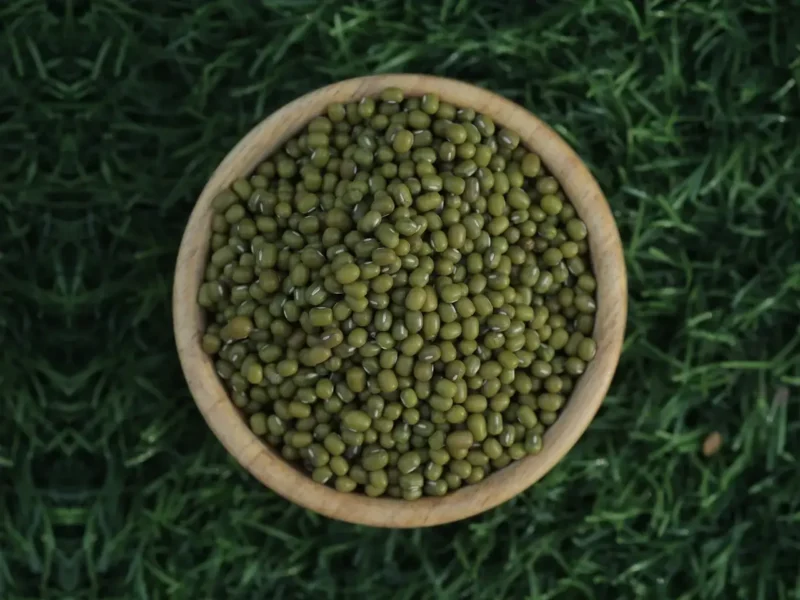
Mung beans size is measured by the round-hole screen a bean stays on, and most export green moong falls between 3.25 mm and 4.5 mm. Grades combine that size with cleaning level and purity, from machine-cleaned FAQ at 3.25 mm and 98% purity to bold sprouting grade at 3.5–4.5 mm and 99% or more. Size decides how the beans cook, sprout and look in a retail pack, so it is one of the first things to fix in a contract. This guide explains how moong is sized, which grades exist, and which quality limits to ask for.
Key takeaways
- Moong is sized on round-hole screens. Export lots usually measure 3.25–4.5 mm, and bold beans are 3.5 mm and above.
- The main grades are machine-cleaned (FAQ), sortex, bold sprouting grade and polished.
- Sprouting buyers need bold, even beans plus germination and hygiene data, not just purity.
- Moisture, foreign matter, damage and pesticide limits matter as much as size.
What Are Mung Bean Sizes and Grades?
A mung bean grade describes three things: how big the beans are, how clean the lot is, and what the beans are meant for. Size is given in millimetres, based on the screen used in grading. Cleaning level is either machine-cleaned or sortex (optical colour sorting). The end use, such as dal milling, retail packing or sprouting, decides which combination you need.
Mung bean (Vigna radiata), also called green gram or green moong, is a small, oval, green pulse. India is the world’s largest moong grower. Rajasthan grows about 40% of India’s crop, followed by Madhya Pradesh and Maharashtra. There are two crops a year: kharif moong, harvested in September and October, and summer moong, harvested in June. Bean size and colour vary with variety, season and rainfall, so a buyer should always name the crop year and grade in the contract.
How Are Mung Beans Sieved and Sized?
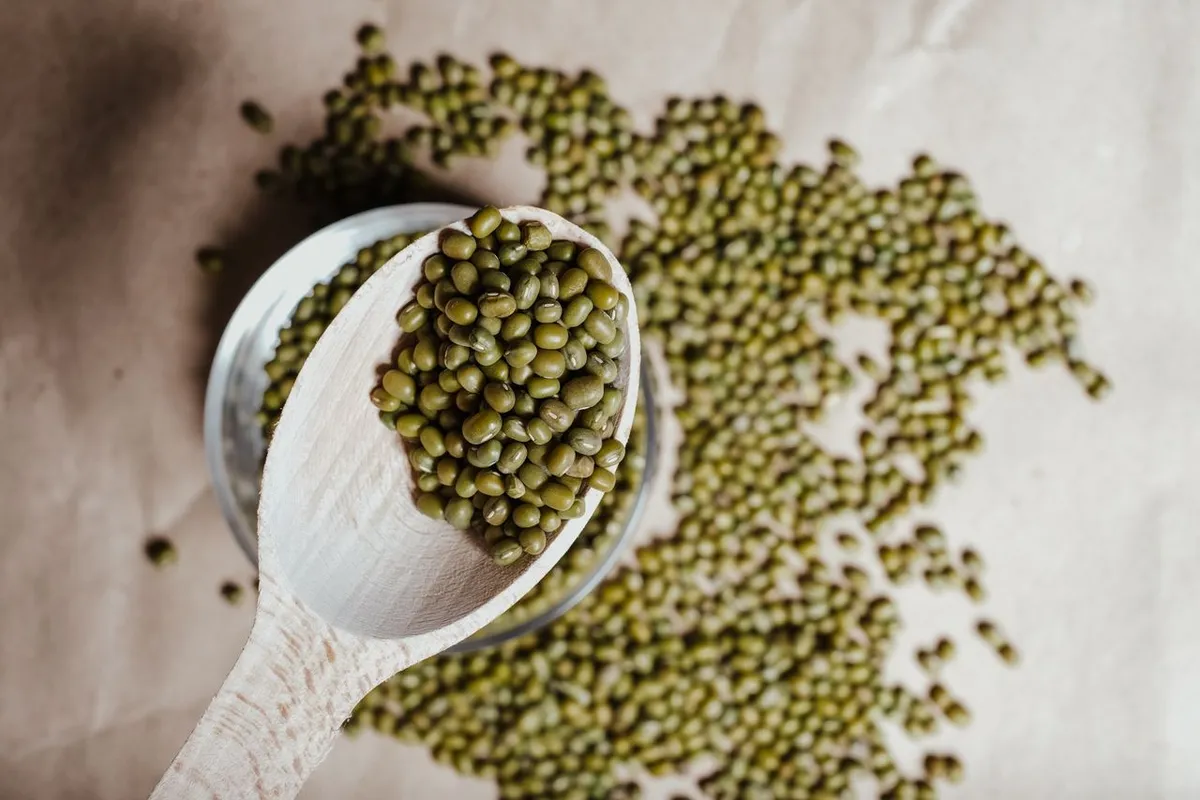
Mung beans are sized by passing them over vibrating screens with round holes. A bean that does not fall through a 3.5 mm hole is counted as 3.5 mm or bigger. A lot described as “3.5 mm+” should therefore have most of its beans retained on a 3.5 mm screen.
In a cleaning plant, the process usually runs in this order:
- Pre-cleaning: removes stones, dust, straw and large foreign matter.
- Destoning and gravity separation: separates light, hollow or immature beans from sound ones.
- Screening: splits the lot into size fractions on round-hole screens, such as below 3.25 mm, 3.25–3.5 mm and above 3.5 mm.
- Sortex sorting: optical sorters remove discoloured, black, shrivelled or damaged beans.
- Polishing (optional): gives the beans a shiny surface for certain retail markets.
Small beans removed by screening are not wasted. They are often sold for dal milling or local use. This is why bold, uniform grades cost more: they come from a smaller share of each lot.
Size also affects how the beans behave in use. Even beans cook in the same time, so a pot of whole moong does not end up with some beans soft and others hard. Retail buyers like bold, even beans because they look better through a clear pack. For starch, noodles and flour, size matters much less, and a cheaper machine-cleaned grade is often the better choice. When you compare offers from different suppliers, check that both quotes refer to the same screen size and the same cleaning method. A low price for “3.25 mm+” is not comparable with a price for “3.5 mm+ sortex”.
What Are the Common Mung Bean Grades and Specifications?
Indian green moong is exported in four common grades. The table shows the typical size, purity and main buyers for each.
| Grade | Size | Purity | Key feature | Typical buyers |
|---|---|---|---|---|
| Machine-cleaned (FAQ) | 3.25 mm+ | 98% | Standard cleaning, mixed size | Dal millers, repackers |
| Sortex | 3.5 mm+ | 99–99.9% | Even colour, low damage | Retail packs, food makers |
| Bold sprouting grade | 3.5–4.5 mm | 99%+ | Germination and hard-seed tested; hygiene controls | Bean-sprout growers in Asia and the Gulf |
| Polished / shiny | 3.5 mm+ | Sortex level | Shiny surface | Middle East retail |
Typical export grades for Indian green moong. Your contract specification applies.
Moong grades are not set by one global standard. The Codex standard for pulses (CXS 171) does not cover Vigna radiata. Indian exporters therefore benchmark to the FSSAI pulses standard and to trade standards used in Asia, such as the Myanmar pulses trade standard. Always send your own specification and ask the exporter to quote against it.
What Is the Difference Between Sprouting Grade and Processing Grade?
Sprouting grade is sold for its ability to grow, while processing grade is sold for cooking and milling. That difference changes what you test.
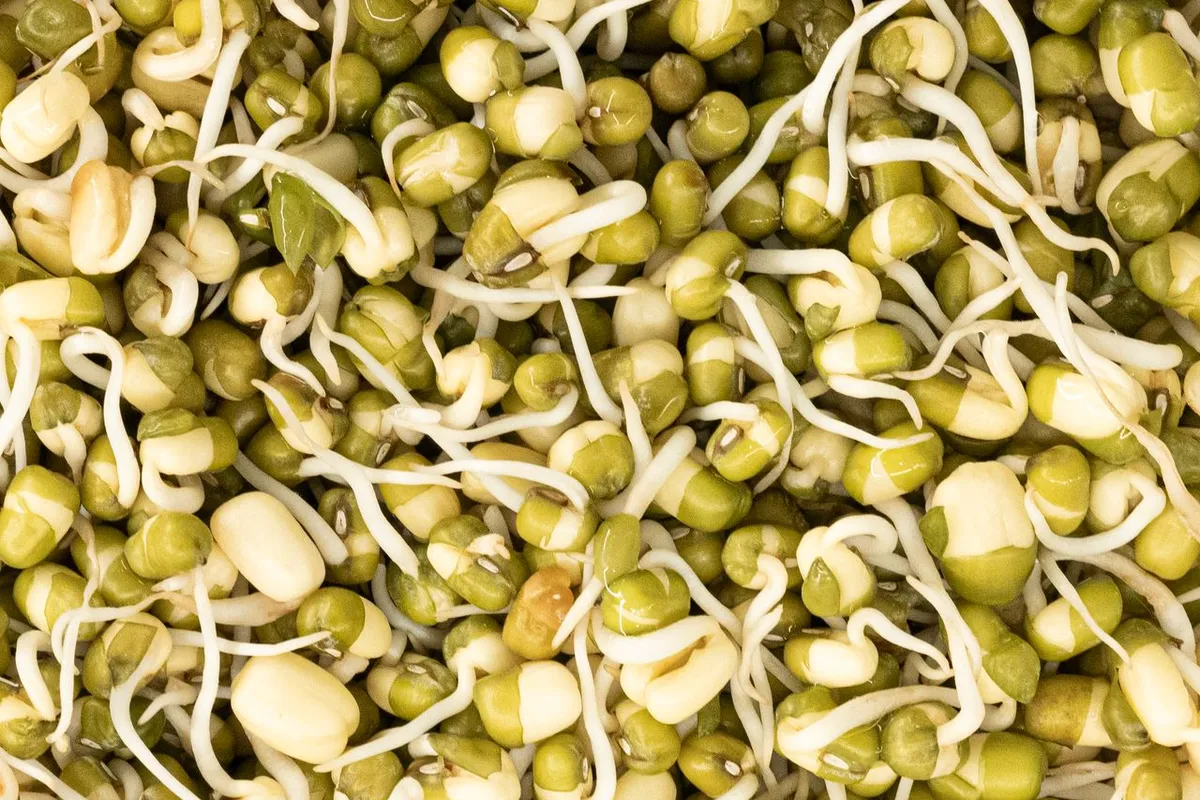
Sprouting grade must be bold and uniform, usually 3.5–4.5 mm, so the beans absorb water and sprout at the same rate. Buyers ask for a germination test and a hard-seed test, because hard seeds do not take up water and stay unsprouted in the batch. Microbial hygiene is critical, since sprouts are often eaten raw or lightly cooked. In the EU, sprouting seed needs an import certificate under Regulation (EU) 211/2013 and traceability under Regulation (EU) 208/2013.
Processing grade covers machine-cleaned and sortex beans used for dal, flour, starch, glass noodles, snacks and desserts. Size uniformity matters less, especially for dal milling, where beans are split anyway. Purity, moisture and pesticide limits are the main concerns.
Which Forms Are Available: Whole, Split and Hulled?
Mung beans are traded in three main forms. Each has its own name in the Indian trade, and each is graded differently.
- Whole green moong: the complete bean with its green skin. It is graded by screen size, as above.
- Split moong with skin (moong chilka): the bean is split into two halves but keeps its green skin. It cooks faster than whole moong.
- Split and dehusked (moong mogar or yellow moong dal): the skin is removed and the bean is split, leaving bright yellow halves. Our moong mogar is specified as 98% retained on a 2.0 mm sieve, with moisture of 12% maximum.
Split forms are sized on smaller screens than whole beans, because each piece is only half a bean. Moisture limits are also stricter for dehusked pulses: FSSAI allows 14% for whole pulses but 12% for dehusked or split pulses.
Which Quality Parameters Matter: Purity, Moisture and Defects?
Size is only one part of a mung bean specification. A complete contract also limits moisture, foreign matter, damage and contaminants. Our standard export specification for whole green moong is:
- Purity: 98% for machine-cleaned and 99–99.9% for sortex.
- Moisture: 12% maximum, against an FSSAI legal maximum of 14% for whole pulses.
- Foreign matter: 0.5% maximum.
- Damaged beans: 2% maximum. Weevilled beans: 1% maximum.
- Broken or split beans: 2% maximum.
- Lead and cadmium: 0.20 mg/kg and 0.040 mg/kg maximum, in line with the EU limits for pulses in Regulation (EU) 2023/915.
- Pesticide residues: within EU or destination maximum residue limits.
- Live insects: nil. Lots are fumigated before loading where needed.
Colour should be uniform, either shiny or dull green as agreed. A lot with many dull, black or shrivelled beans usually points to weather damage or old crop. Ask for a pre-shipment sample and a Certificate of Analysis for your exact lot. Our lab testing page lists the tests we run on pulses.
Related reading: Types of Lentils: Red, Green, Brown and Black Compared and Types of Dal: Toor, Chana, Moong, Urad and Masoor Explained.
How Do You Buy Green Moong Beans in Bulk from India?
Start by matching mung beans size and grade to your end use, then ask for a type sample. Name the crop year, screen size, cleaning level, moisture and packing in the contract. Most export moong is packed in 25 or 50 kg PP or BOPP bags, or 1 MT jumbo bags. A 20 ft container carries about 24–26 MT, and a 40 ft high cube about 26–28 MT. Our container load calculator helps you plan the load. Whole moong ships under HS 0713 31 90.
Timing also matters. New-crop beans are usually brighter and more even in colour, so buying soon after the kharif or summer harvest gives you the widest choice of bold lots. Our crop calendar shows the main harvest windows. For a first order, approve a type sample, then a pre-shipment sample from your actual lot, before the container is loaded.
Elysium Agri Corporation exports green moong beans from Jamnagar, Gujarat, in machine-cleaned, sortex, bold sprouting and polished grades. Every lot is tested for moisture, admixture, pesticides and heavy metals, and we provide a phytosanitary certificate, certificate of origin and Certificate of Analysis with each shipment. You can see our other pulses and check our registrations on the certificates page.
Tell us the grade, size, quantity and destination port, and we will send an FOB or CIF price with the specification sheet. Request a green moong quote →
Frequently asked questions
What are the different grades of mung beans?
Indian green moong is usually exported as machine-cleaned FAQ grade (3.25 mm+, 98% purity), sortex grade (3.5 mm+, 99–99.9% purity), bold sprouting grade (3.5–4.5 mm, 99%+, germination tested) and polished or shiny grade for some Middle East retail markets. The right grade depends on whether you mill, pack, cook or sprout the beans.
How is mung bean size measured and graded?
Mung beans are passed over vibrating screens with round holes of set diameters. A bean that stays on a 3.5 mm screen is counted as 3.5 mm or larger. Plants split each lot into size fractions, then remove discoloured or damaged beans with optical sortex machines. Export lots usually fall between 3.25 and 4.5 mm.
What is the difference between green moong and split moong?
Green moong is the whole bean with its green skin. Split moong is the same bean broken into two halves. Moong chilka keeps the green skin, while moong mogar, or yellow moong dal, has the skin removed. Split forms cook faster, are sized on smaller screens, and have a stricter FSSAI moisture limit of 12%.
Which mung bean size is best for sprouting?
Bold, uniform beans of about 3.5 to 4.5 mm are preferred for sprouting, because even beans absorb water and sprout at the same rate. Sprouting buyers also ask for germination and hard-seed tests and strict hygiene controls. In the EU, sprouting seed also needs an import certificate and full traceability records.
What purity level should export-quality mung beans have?
Export green moong is normally 98% pure for machine-cleaned grade and 99 to 99.9% for sortex grade. A full specification also limits moisture to about 12%, foreign matter to 0.5%, damaged beans to 2% and weevilled beans to 1%, and sets lead, cadmium and pesticide limits for the destination market.
Related reads


